


Summary
Proposed cuts to the CDC's NHIS may severely impact clinical studies that rely on federal health survey data for benchmarking and regulatory submissions. Sponsors should audit their data dependencies under GDPR and assess the implications for data quality and governance. The iliomad framework can aid in managing these risks effectively.
Summary: Proposed cuts to the United States Centers for Disease Control and Prevention (CDC) National Health Interview Survey (NHIS), reducing its questions from 482 to 150, threaten to widen an already significant undercount of people with disabilities. For sponsors conducting clinical studies that rely on federal survey data as a real-world-evidence benchmark or health-equity reference, this shift creates measurable gaps in external comparator data, complicates cross-border data benchmarking and may affect the reliability of regulatory submissions. Sponsors operating under the General Data Protection Regulation (GDPR), Regulation (EU) No 536/2014 on clinical trials (EU CTR) and ICH Good Clinical Practice (GCP) guidelines should audit their dependence on US federal public health datasets now.
What is the NHIS and why does it matter for clinical studies?
The National Health Interview Survey (NHIS) is the United States' flagship annual household health survey, administered by the CDC's National Center for Health Statistics (NCHS) since 1957, collecting population-level health data used by researchers, regulators and policymakers. For sponsors running clinical studies, the NHIS serves as a reference population dataset, enabling external control arms, health-equity analyses and real-world-evidence (RWE) submissions to agencies including the US Food and Drug Administration (FDA) and the European Medicines Agency (EMA).
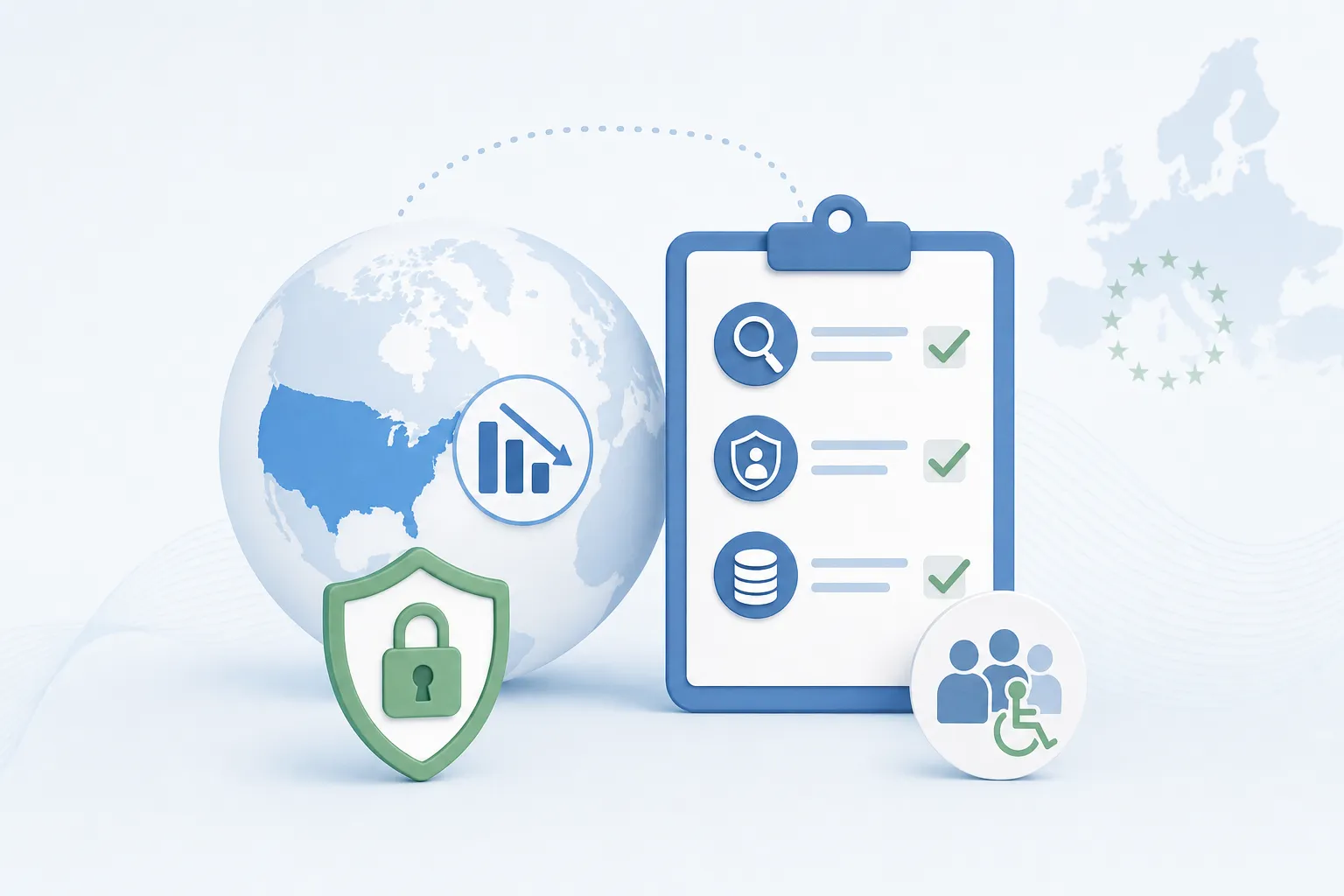
In August 2026, the NCHS proposed a major overhaul of the NHIS. The redesign would reduce the adult questionnaire from 482 questions to 150, eliminating items on hearing aids, cognition, fatigue, mobility supports such as wheelchairs and scooters, and a range of functional disability indicators. The surveyed household panel would be reduced to approximately 25,000 households. A Department of Health and Human Services (HHS) spokesperson confirmed the motivation is cost reduction, as reported by STAT News on 1 October 2026.
For life sciences organisations, the implications extend well beyond domestic US health policy. Any sponsor using NHIS data as a benchmark population, an external comparator or a health-equity stratification layer in a clinical study protocol should treat this as a material data governance event.
The iliomad data-dependency framework for clinical studies
Iliomad's data-dependency framework helps sponsors systematically identify, document and mitigate reliance on third-party public health datasets within the data governance architecture of a clinical study. The framework operates across three sequential layers.
Layer 1: Dataset audit. Sponsors identify every external public health dataset referenced in the clinical study protocol, the statistical analysis plan (SAP) or the integrated summary of efficacy and safety. Each dataset is classified by jurisdiction, update frequency, collection methodology and governance stability.
Layer 2: Regulatory impact assessment. For each dataset, the sponsor assesses the regulatory consequence of degraded data quality or discontinuation. Under EU CTR Article 25, sponsors must ensure that participant data is collected in a manner consistent with the protocol and scientifically valid. Where a reference population dataset loses validity through redesign or truncation, the sponsor must document the impact and notify the relevant ethics committee and competent authority.
Layer 3: Contingency mapping. For datasets assessed as high-dependency or high-risk, the sponsor identifies alternative sources, including European Health Data Space (EHDS) repositories, national registries and proprietary real-world datasets, and documents the transition pathway.
This framework is particularly relevant for sponsors operating decentralised clinical trials (DCTs), in which remote data collection already amplifies dependence on external population references for protocol feasibility and statistical power calculations.
How does the NHIS redesign affect cross-border data benchmarking under GDPR?
The GDPR does not directly regulate US federal health surveys, but it does govern how European sponsors and contract research organisations (CROs) process personal data derived from or compared against those surveys. The intersection arises in three practical scenarios.
Scenario 1: External control arms. Where a sponsor uses NHIS aggregate data to construct a synthetic or external control arm under an EU-authorised clinical study, the protocol must describe the reference dataset's collection methodology. If that methodology changes materially, Article 58 of EU CTR requires the sponsor to notify the Member State competent authority of a substantial modification.
Scenario 2: Health-equity submissions. EMA's reflection paper on the use of real-world data in regulatory decision-making encourages sponsors to document the representativeness of reference populations. Removing disability-related questions from the NHIS will deepen existing undercounts. Research cited by STAT News indicates the survey already missed an estimated 75 per cent of people with intellectual and developmental disabilities before the proposed cuts. Sponsors relying on NHIS disability prevalence figures in regulatory submissions must reassess the validity of those figures.
Scenario 3: Cross-border data transfers. Sponsors transferring clinical study data from the EU to the US, whether via standard contractual clauses (SCCs) under GDPR Articles 46(2)(c) and (d) or binding corporate rules (BCRs), must conduct transfer impact assessments (TIAs). A TIA evaluates not only the legal protections available to data subjects in the destination country but also the adequacy of data infrastructure. Systemic degradation of federal health data infrastructure is a relevant factor in assessing whether the US environment continues to support the scientific and regulatory purposes for which the transfer is made.
Focus: the example of France
In France, sponsors conducting clinical studies must submit a declaration or authorisation to the Commission Nationale de l'Informatique et des Libertés (CNIL) before processing health data. The CNIL's Méthodologie de Référence MR-001 (MR-001) governs standard research uses and defines the conditions under which reference population data may be incorporated into a study's data governance framework. Where a sponsor's protocol references a foreign public health dataset such as the NHIS, the CNIL expects the sponsor to document that dataset's provenance, completeness and governance in the Data Protection Impact Assessment (DPIA) prepared under GDPR Article 35. A material reduction in NHIS data quality may therefore require sponsors to update existing MR-001 declarations.
Focus: the example of the United Kingdom
In the United Kingdom, the Information Commissioner's Office (ICO) oversees data protection compliance for clinical studies conducted under the UK GDPR, which mirrors the EU GDPR following the UK's departure from the European Union. The ICO's guidance on research exemptions and the Health Research Authority's (HRA) Combined Review process both require sponsors to identify the basis on which external datasets are used and to confirm their scientific validity. Where NHIS data underpins a UK-authorised clinical study's comparator population, sponsors should review whether the proposed redesign triggers a protocol amendment notification to the HRA.
Focus: the example of the European Data Protection Board
The European Data Protection Board (EDPB), the body responsible for ensuring consistent application of GDPR across EU Member States, has issued guidance on the processing of health data for research purposes under Article 9(2)(j) GDPR. The EDPB's Opinion 3/2019 on processing of personal data through video devices, and more broadly its guidance on scientific research, confirms that data quality and representativeness are integral to the lawfulness of health research processing. Where a sponsor's scientific research purpose depends on population data that is no longer representative due to a survey redesign, the EDPB's framework implies a duty to reassess the legal basis and the DPIA.
Comparing the regulatory response obligations across jurisdictions
The table below summarises the key regulatory obligations triggered for sponsors when an external reference dataset used in a clinical study undergoes a material change.
The nFADP is Switzerland's revised Federal Act on Data Protection, which entered into force on 1 September 2023 and aligns closely with GDPR principles.
Practical steps for sponsors relying on US federal health data
Sponsors should take the following actions in response to the NHIS redesign proposal.
- Audit protocol dependencies. Review all active and planned clinical study protocols to identify where NHIS data is cited as a reference population, comparator dataset or health-equity benchmark.
- Update DPIAs. Under GDPR Article 35 and the EDPB's guidelines on DPIAs, sponsors must review their impact assessments when the risk profile of a processing activity changes. A degraded external dataset constitutes a change in scientific validity risk.
- Identify alternative data sources. European alternatives include Eurostat health statistics, national disease registries and the forthcoming EHDS, established under Regulation (EU) 2025/327 on the European Health Data Space, which creates a framework for secondary use of electronic health data across Member States.
- Brief clinical operations teams. Clinical operations leads, site monitors and data managers should be informed of the dependency audit outcomes so that site-level data collection plans can be adjusted where necessary.
- Engage legal and regulatory counsel. Where protocol amendments are required, sponsors should engage regulatory counsel early to avoid delays in ethics committee and competent authority timelines under EU CTR Articles 14 to 23.
- Review SCCs and TIAs. Any standard contractual clauses in place for transfers of clinical study data to or from the United States should be reviewed to confirm that the TIA remains valid in light of changing federal data infrastructure.
Iliomad advises biotech and pharma sponsors, CROs and healthtech organisations on GDPR compliance, cross-border data transfers and clinical trial data governance across the EU, UK and Switzerland. If your clinical studies rely on US federal health datasets or require a DPIA review in light of changing real-world data sources, our clinical trials data protection team can help you audit your exposure and update your compliance framework.
Speak to iliomad about clinical trial data governance
FAQs
Our frequently questions
Sponsors should take six key actions without delay: (1) Audit all active and planned clinical study protocols to identify where NHIS data is cited as a reference population, comparator dataset or health-equity benchmark. (2) Update DPIAs under GDPR Article 35 to reflect the changed scientific validity risk. (3) Identify alternative data sources such as Eurostat, national registries or EHDS repositories. (4) Brief clinical operations teams — including site monitors and data managers — on audit outcomes so site-level data collection plans can be adjusted. (5) Engage legal and regulatory counsel early to manage any required protocol amendments within EU CTR Articles 14 to 23 timelines. (6) Review all SCCs and TIAs governing US data transfers to confirm they remain valid in light of degrading federal health data infrastructure.
Sponsors should proactively identify and document alternative reference population sources. European alternatives include Eurostat health statistics, national disease registries, and the forthcoming European Health Data Space (EHDS), established under Regulation (EU) 2025/327, which creates a framework for secondary use of electronic health data across EU Member States. For sponsors running decentralised clinical trials (DCTs), where reliance on external population references is already amplified, contingency mapping should be prioritised. Iliomad's data-dependency framework provides a structured three-layer approach — dataset audit, regulatory impact assessment and contingency mapping — to help sponsors transition away from high-risk external datasets systematically.
In France, sponsors must submit a declaration or authorisation to the CNIL before processing health data. Under the CNIL's Méthodologie de Référence MR-001, sponsors are expected to document the provenance, completeness and governance of any referenced foreign public health dataset — such as the NHIS — in their DPIA. A material reduction in NHIS data quality may require sponsors to update existing MR-001 declarations. In the United Kingdom, the ICO and the Health Research Authority's (HRA) Combined Review process require sponsors to confirm the scientific validity of external datasets. Where NHIS data underpins a UK-authorised clinical study's comparator population, sponsors should assess whether the proposed redesign triggers a protocol amendment notification to the HRA under UK GDPR.
Under GDPR Article 35, sponsors must review and update their Data Protection Impact Assessment (DPIA) whenever the risk profile of a processing activity changes — and a degraded or redesigned external dataset constitutes a change in scientific validity risk. Additionally, under EU CTR Article 25, sponsors must ensure participant data is collected in a manner consistent with the protocol and scientifically valid. If a reference population dataset loses validity through redesign or truncation, the sponsor must document the impact and notify the relevant ethics committee and competent authority. Sponsors using NHIS data in EU-authorised clinical studies should also review their Standard Contractual Clauses (SCCs) and Transfer Impact Assessments (TIAs) for cross-border data transfers to or from the United States.
The proposed NHIS redesign eliminates questions on hearing aids, cognition, fatigue, mobility supports (such as wheelchairs and scooters) and a range of functional disability indicators. This significantly deepens an already critical undercount: research cited by STAT News indicates the survey already missed an estimated 75% of people with intellectual and developmental disabilities before these cuts. For clinical study sponsors relying on NHIS disability prevalence figures in regulatory submissions — particularly for health-equity stratification or representativeness documentation required by the EMA — the scientific validity of those figures must now be urgently reassessed.
The National Health Interview Survey (NHIS) is the United States' flagship annual household health survey, administered by the CDC's National Center for Health Statistics since 1957. For clinical study sponsors, it serves as a key reference population dataset used to build external control arms, conduct health-equity analyses and support real-world evidence (RWE) submissions to agencies such as the FDA and EMA. In August 2026, the NCHS proposed cutting the adult questionnaire from 482 to 150 questions, eliminating critical disability indicators. This redesign represents a material data governance event for any sponsor relying on NHIS data as a benchmark or comparator population in their clinical study protocols.

Find out how iliomad can help your company.
Only visible in production
Vendor clinical trials: audit trails, logging gaps and sub-processor obligations
Understand vendor GDPR obligations in clinical trials, including audit-trail requirements, sub-processor controls and breach notification under Articles 28, 33 and 34.
iliomad Weekly Digest: AI in Clinical Research, EU Health Data Rules, Cybersecurity and Regulatory Enforcement
This week: ARPA-H SURPASS trials programme, EHDS metadata rules, EDPB fine methodology, Citrix zero-days, Labcorp settlement and AI health-data governance.
GDPR Article 89 research: lawful basis and safeguards for clinical trials
Understand how GDPR Article 89 enables lawful processing of personal data in clinical research, what safeguards apply, and how sponsors can comply across the EU.
