


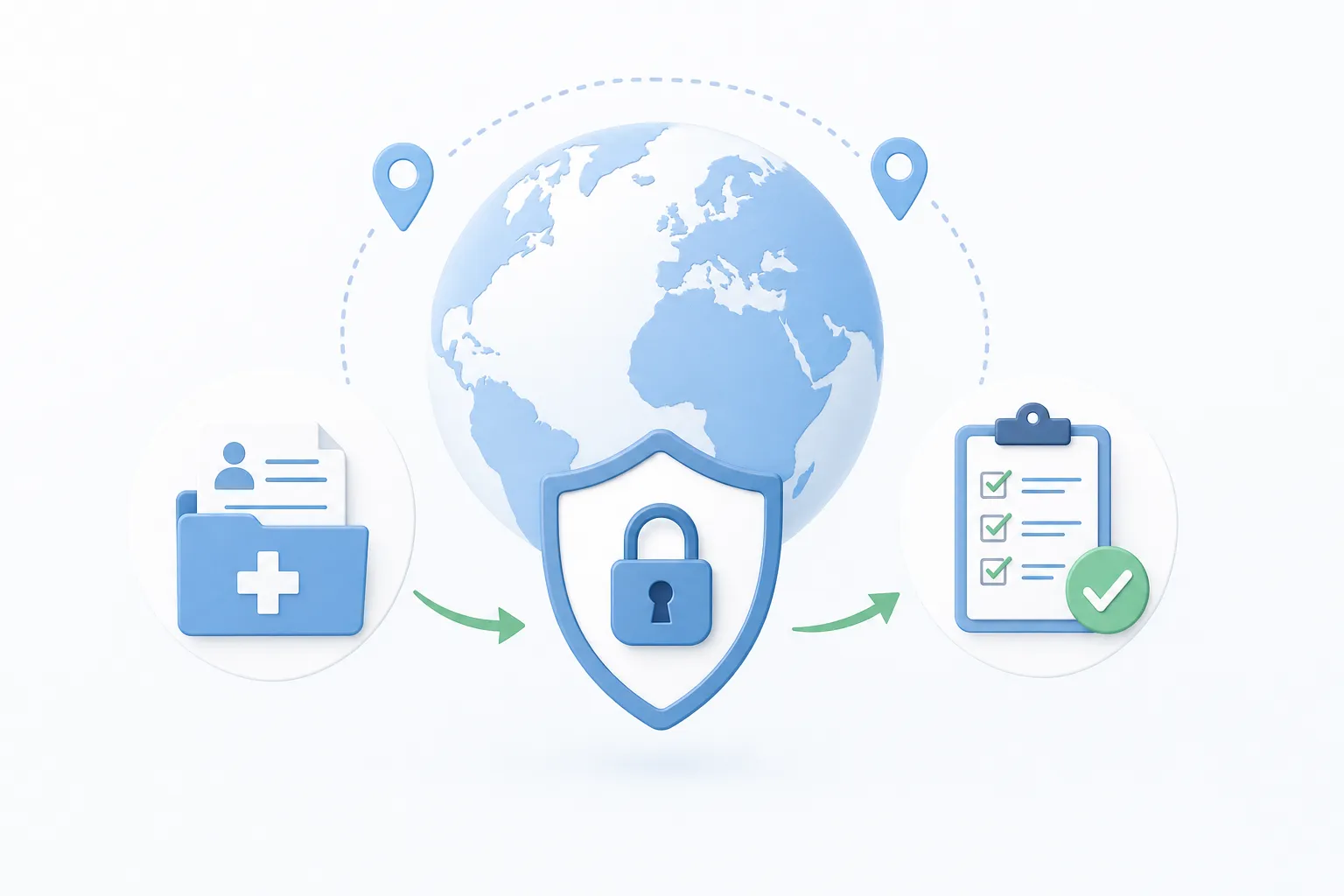
Summary
This guide addresses the complexities of data transfer compliance for sponsors in global clinical trials under GDPR and local frameworks. It outlines essential legal instruments, procedures for transfer impact assessments, and the specific requirements for maintaining compliance while handling sensitive personal data across different jurisdictions.
Global clinical trials generate extraordinary volumes of sensitive personal data, transferred daily between sponsors, contract research organisations (CROs), investigator sites, central laboratories and regulatory authorities spread across multiple jurisdictions. Achieving data transfer compliance, which means satisfying every applicable legal requirement before personal data crosses a national border, is one of the most operationally complex obligations a sponsor faces. With geopolitical shifts such as Canada's reported discussions on EU associate membership (Forbes, September 2026) beginning to blur established jurisdictional boundaries, sponsors who build a robust, instrument-anchored transfer framework today will be best placed to adapt as the regulatory map evolves.
This guide sets out the core legal instruments, the practical mechanics of transfer impact assessments, and the country-specific formalities that clinical trial sponsors must navigate to keep global studies on schedule and inspection-ready.
What does data transfer compliance mean for clinical trial sponsors?
Data transfer compliance, in a clinical trial context, is the obligation imposed on a sponsor (acting as data controller under Article 4(7) of Regulation (EU) 2016/679, the General Data Protection Regulation or GDPR) to ensure that any transfer of participant personal data to a third country is covered by one of the mechanisms listed in Chapter V of the GDPR before that transfer takes place. Without a valid transfer mechanism in place, even a routine data export to a US-based sponsor headquarters can constitute a breach attracting fines of up to €20 million or 4 % of global annual turnover under Article 83(5) GDPR.
For clinical trials specifically, the obligation is compounded by the EU Clinical Trials Regulation 536/2014 (EU CTR), which requires that trial data processed under the CTIS portal remain subject to GDPR-equivalent protections regardless of where the sponsor is established. Sponsors must therefore map every data flow at the protocol design stage, not retrospectively.
The five transfer mechanisms most relevant to clinical trials
The GDPR provides a hierarchy of lawful transfer tools. The table below compares the five instruments sponsors most commonly rely on.
How should a sponsor structure a transfer impact assessment for a multisite trial?
A transfer impact assessment (TIA), also called a transfer risk assessment, is a documented evaluation that a data exporter must perform before relying on SCCs to transfer personal data to a country that lacks an adequacy decision, in order to verify that the clauses can be effective in practice given the legal environment of the destination country. The obligation arises from Clause 14 of the 2021 SCCs and was confirmed by the Court of Justice of the EU in its Schrems II judgment (Case C-311/18, 16 July 2020).
For a Phase III trial running across the EU, the United States and South Korea, a sponsor would typically conduct a TIA in three sequential steps.
Step 1: Data flow mapping. Every category of participant data (demographics, genomic sequences, ePRO outputs, imaging files) is logged against the recipient, the recipient's country and the legal basis for the transfer. This mapping feeds directly into the clinical study protocol's data protection annex and into the trial master file (TMF) under ICH E6(R3) GCP requirements.
Step 2: Legal landscape assessment. The sponsor, usually with external counsel, analyses whether the destination country's surveillance laws, data localisation rules or government access powers could prevent the CRO or site from honouring the SCCs. The European Data Protection Board (EDPB) Recommendations 01/2020 on supplementary measures (updated June 2021) provide the analytical framework, identifying six categories of supplementary measures ranging from pseudonymisation to contractual and organisational controls.
Step 3: Supplementary measures and residual risk determination. Where the legal assessment identifies a gap, the sponsor selects and documents supplementary measures. Pseudonymisation of participant identifiers before export, combined with encryption in transit and at rest using keys held within the EEA, is the most widely accepted technical measure for clinical data. If residual risk remains high and cannot be mitigated, the transfer should not proceed.
The completed TIA must be stored in the TMF and made available to the competent supervisory authority on request under Article 58(1)(a) GDPR.
Focus: The example of France and the CNIL
The Commission Nationale de l'Informatique et des Libertés (CNIL) is the French supervisory authority responsible for enforcing the GDPR and national implementing law (Loi Informatique et Libertés). For clinical trials, the CNIL has published the Méthodologie de Référence MR-001, a specific authorisation framework for interventional studies involving human subjects. MR-001 requires sponsors to document cross-border transfers explicitly in their CNIL declaration and to confirm that a valid transfer mechanism exists for every third country recipient. Sponsors who transfer pseudonymised clinical data to a US-based EDC vendor must therefore attach a completed TIA and verified DPF certification to their MR-001 file before the study opens in France.
Focus: The example of Germany and the Bavarian DPA
Germany's federal structure means that each of the 16 Länder has its own data protection authority. The Bayerisches Landesamt für Datenschutzaufsicht (BayLDA), which supervises private-sector entities in Bavaria, has published guidance emphasising that SCCs alone are insufficient without a documented TIA for US transfers post-Schrems II. Sponsors running trials at Munich-based university hospitals should ensure that their clinical site agreements explicitly assign TIA obligations to the sponsor and that a copy is held at the site for inspection.
Focus: The example of the United Kingdom and the ICO
Following the UK's departure from the EU, the Information Commissioner's Office (ICO) developed its own transfer mechanism: the International Data Transfer Agreement (IDTA) and an addendum to the EU SCCs, both effective from 21 March 2022 under the UK GDPR (as retained by the Data Protection Act 2018). Sponsors transferring data from UK investigator sites to EU sponsor headquarters must use either the IDTA or the UK addendum, not the EU SCCs alone. The ICO's Transfer Risk Assessment (TRA) tool follows a similar but not identical methodology to the EDPB's TIA framework, and sponsors should ensure their documentation satisfies both where a trial runs across the UK and EEA simultaneously.
Focus: The example of Canada and the evolving adequacy landscape
Canada currently benefits from a European Commission adequacy decision covering transfers governed by the Personal Information Protection and Electronic Documents Act (PIPEDA). A Forbes report dated September 2026 indicated that Canada is in active discussions regarding EU associate membership, a development that could significantly reshape the legal basis for EU-Canada data flows in clinical research. Sponsors with ongoing or planned trials involving Canadian sites should monitor these discussions closely. If Canada's status were formalised as an associate member with GDPR alignment obligations, sponsors could gain a more stable and auditable transfer basis than the existing adequacy decision, which is subject to periodic review. Iliomad recommends that sponsors document current transfer arrangements carefully so that any transition can be managed without disrupting patient data flows or ethics committee approvals.
What are the operational steps for embedding transfer compliance into a clinical trial?
Data transfer compliance is not a one-time legal exercise. It must be embedded into each operational phase of the trial, from protocol drafting through to archiving.
Protocol and DPIA integration. The clinical study protocol's data protection section (often called Section 13) should identify all third-country recipients at the outset. A Data Protection Impact Assessment (DPIA), required under Article 35 GDPR when processing is likely to result in a high risk, such as large-scale processing of health data, should be completed before the trial opens and updated if the data flows change materially.
Clinical site agreements. Each clinical site agreement (CSA) must include data transfer clauses that assign responsibility for export controls, specify the transfer mechanism in use and oblige the site to notify the sponsor promptly if local law changes in a way that affects the validity of that mechanism. The EU CTR Article 49 requires that agreements between sponsors and sites be in place before a site is activated, making early legal review essential.
Vendor onboarding. Every technology vendor, whether an electronic data capture (EDC) provider, an ePRO/eDiary platform or a central imaging laboratory, must be onboarded as a data processor under a data processing agreement (DPA) compliant with Article 28 GDPR. The DPA must specify the sub-processing chain, because Article 28(2) prohibits a processor from engaging a sub-processor without the controller's prior written authorisation. Sponsors should maintain a vendor register as part of their Records of Processing Activities (RoPA) under Article 30 GDPR.
Ongoing monitoring. Transfer mechanisms are not static. Adequacy decisions can be revoked, DPF certifications can lapse and national laws can change. Sponsors should build a quarterly review of their transfer register into their data governance calendar and ensure that their Data Protection Officer (DPO), where appointed under Article 37 GDPR, is consulted on any material change.
Focus: The example of Spain and the AEPD
The Agencia Española de Protección de Datos (AEPD) is the Spanish supervisory authority and has been among the more active EU regulators in scrutinising clinical trial data transfers. The AEPD published guidance in 2022 noting that sponsors must be able to demonstrate, at the time of any inspection, that each transfer mechanism was valid at the moment the transfer occurred, not merely at the time of the investigation. Sponsors running Spanish sites should therefore timestamp their TIAs and SCC execution records with the date of first data transfer, retaining those records for the duration of the trial retention period, which under Spanish law implementing the EU CTR can extend to 25 years for certain medicinal product trials.
Focus: The example of Japan and the APPI framework
Japan holds a mutual adequacy arrangement with the EU under which transfers from Japan to the EEA are treated as equivalent to domestic transfers, and transfers from the EEA to Japan are covered by the European Commission's adequacy decision of January 2019. For sponsors running Asia-Pacific arms of a global trial with Japanese sites, this is a material operational advantage. However, Japan's Act on the Protection of Personal Information (APPI), as amended in 2022, introduces additional obligations on foreign data recipients, including notification requirements that sponsors must factor into their informed consent forms and cross-border transfer annexes.
Building a scalable transfer compliance framework: the iliomad funnel approach
A scalable transfer compliance framework is one that establishes GDPR as the baseline standard and then layers jurisdiction-specific requirements on top, so that country adaptations are additive rather than conflicting. Iliomad refers to this as the funnel approach: the widest part of the funnel captures the universal principles of the GDPR, the core of the funnel captures the SCC and TIA mechanics, and the narrow outlet delivers country-specific documentation adapted to local supervisory authority expectations.
Applied to data transfer compliance, the funnel approach works as follows. First, the sponsor's data governance team identifies every transfer relationship at the protocol design stage and selects the appropriate mechanism for each. Second, standard SCC modules (Module 1 for controller-to-controller, Module 2 for controller-to-processor) are executed with all relevant counterparties before data first flows. Third, TIAs are drafted for every non-adequate country, reviewed by the DPO and stored in the TMF. Fourth, country-specific overlays, such as MR-001 declarations in France, IDTA execution for UK sites and APPI annexes for Japanese sites, are added to the master documentation package. Fifth, the entire framework is reviewed at each substantial protocol amendment and at least annually.
This structured approach reduces the risk of a transfer being challenged by a supervisory authority on the grounds that no mechanism was in place, and it provides the inspection-ready audit trail that ICH E6(R3) GCP expects.
Conclusion
Data transfer compliance in global clinical trials is a continuous, instrument-anchored obligation that begins at protocol design and extends through to final archiving. Sponsors must select the correct transfer mechanism for each data flow, conduct and document TIAs for every non-adequate country, integrate transfer clauses into clinical site agreements and vendor contracts, and monitor the legal landscape for changes that could invalidate existing arrangements. Geopolitical developments such as Canada's reported EU associate membership discussions are a reminder that the adequacy map can shift, and that sponsors who maintain a well-documented, adaptable transfer framework are best positioned to respond without disrupting participant data protection or trial timelines.
Iliomad's clinical trials data protection team supports sponsors and CROs across the full lifecycle of transfer compliance, from initial data flow mapping and TIA drafting to supervisory authority submissions and inspection readiness reviews.
Ensure your trial's data transfers are inspection-ready. Contact iliomad's clinical trials data protection team to discuss how we can support your global programme.
FAQs
Our frequently questions
The funnel approach, developed by Iliomad, establishes GDPR as the universal baseline and layers jurisdiction-specific requirements on top so that country adaptations are additive rather than conflicting. It operates in five stages: (1) At protocol design, the data governance team identifies every transfer relationship and selects the appropriate mechanism for each; (2) Standard SCC modules (Module 1 for controller-to-controller, Module 2 for controller-to-processor) are executed with all counterparties before data first flows; (3) TIAs are drafted for every non-adequate country, reviewed by the DPO and stored in the TMF; (4) Country-specific overlays are added — such as MR-001 declarations in France, IDTA execution for UK sites and APPI annexes for Japanese sites; (5) The entire framework is reviewed at each substantial protocol amendment and at least annually. This structured approach reduces the risk of a transfer being challenged by a supervisory authority and provides the inspection-ready audit trail required under ICH E6(R3) GCP guidelines.
Data transfer compliance must be integrated across every operational phase of a trial: (1) Protocol and DPIA integration: the protocol's data protection section should identify all third-country recipients at the outset, and a DPIA must be completed before the trial opens and updated if data flows change materially. (2) Clinical site agreements (CSAs): each CSA must include data transfer clauses assigning responsibility for export controls, specifying the transfer mechanism in use, and obliging the site to notify the sponsor of any local law change affecting that mechanism — this must be in place before site activation per EU CTR Article 49. (3) Vendor onboarding: every technology vendor must be onboarded under an Article 28-compliant Data Processing Agreement (DPA) specifying the sub-processing chain, with all vendors listed in the sponsor's Records of Processing Activities (RoPA). (4) Ongoing monitoring: a quarterly review of the transfer register should be built into the data governance calendar, with the DPO consulted on any material change, as adequacy decisions can be revoked, DPF certifications can lapse and national laws can evolve.
Each country has distinct requirements: In France, the CNIL's Méthodologie de Référence MR-001 requires sponsors to document cross-border transfers explicitly in their CNIL declaration and confirm a valid transfer mechanism exists for every third-country recipient before the study opens. In Germany, the BayLDA (Bavaria's DPA) emphasises that SCCs alone are insufficient without a documented TIA for US transfers post-Schrems II; clinical site agreements must explicitly assign TIA obligations to the sponsor. In the UK, sponsors must use the ICO's International Data Transfer Agreement (IDTA) or the UK addendum to EU SCCs (not EU SCCs alone) for transfers from UK sites, and complete a Transfer Risk Assessment (TRA) following the ICO's own methodology. In Spain, the AEPD requires sponsors to demonstrate that each transfer mechanism was valid at the moment the transfer occurred — not just at the time of investigation — meaning TIAs and SCC execution records must be timestamped and retained for up to 25 years for certain medicinal product trials.
A Transfer Impact Assessment (TIA) for a multisite trial should follow three sequential steps. Step 1 — Data flow mapping: log every category of participant data (demographics, genomic sequences, ePRO outputs, imaging files) against each recipient, their country, and the legal basis for the transfer; this feeds directly into the protocol's data protection annex and the Trial Master File (TMF). Step 2 — Legal landscape assessment: analyse, typically with external counsel, whether the destination country's surveillance laws, data localisation rules or government access powers could prevent recipients from honouring the SCCs, using the EDPB Recommendations 01/2020 as the analytical framework. Step 3 — Supplementary measures and residual risk: where a gap is identified, select documented supplementary measures such as pseudonymisation and encryption with EEA-held keys; if residual risk remains high and cannot be mitigated, the transfer must not proceed. The completed TIA must be stored in the TMF and made available to competent supervisory authorities on request.
The five transfer mechanisms most commonly used by clinical trial sponsors are: (1) Adequacy decisions (Article 45 GDPR), covering countries recognised by the European Commission such as Japan and the UK; (2) Standard Contractual Clauses (SCCs) (Article 46(2)(c) GDPR), used for sponsor-to-CRO, sponsor-to-lab and vendor transfers, but requiring a Transfer Impact Assessment (TIA) where destination laws may undermine them; (3) Binding Corporate Rules (BCRs) (Article 47 GDPR), suited for intra-group transfers but requiring 12–18 months of approval; (4) Derogations for research (Article 49(1) GDPR), applicable only where no other mechanism is available and strictly interpreted by supervisory authorities; and (5) Sector-specific adequacy such as the EU-US Data Privacy Framework (DPF), where each US recipient's certification must be individually verified.
Data transfer compliance, in a clinical trial context, is the obligation imposed on a sponsor (acting as data controller under Article 4(7) GDPR) to ensure that any transfer of participant personal data to a third country is covered by one of the mechanisms listed in Chapter V of the GDPR before that transfer takes place. Without a valid transfer mechanism, even a routine data export to a US-based sponsor headquarters can constitute a breach attracting fines of up to €20 million or 4% of global annual turnover. Under the EU Clinical Trials Regulation 536/2014, trial data processed via the CTIS portal must remain subject to GDPR-equivalent protections regardless of where the sponsor is established, making it essential to map every data flow at the protocol design stage.

Find out how iliomad can help your company.
Only visible in production
MR-001 CNIL: what clinical trial sponsors must know about French health data compliance
Understand MR-001 CNIL obligations for clinical trial sponsors in France, from Article 32 security requirements to breach notification and cross-border data transfers.
ICF Boilerplate and Open-Access Database Disclosures: What Clinical Trial Sponsors Must Know
Learn how US site ICF boilerplate on commercial products and open-access genetic databases affects sponsor data governance, Common Rule compliance and GDPR obligations.
iliomad Weekly Digest: DPO Conflicts, Bulk Data Rules, Healthcare Cyber Incidents and AI Transparency
This week: CNIL on DPO conflicts of interest, DOJ bulk data rule for life sciences, wave of healthcare ransomware attacks, Uber's €825m GDPR fine and AI disclosure demands.
