


Summary
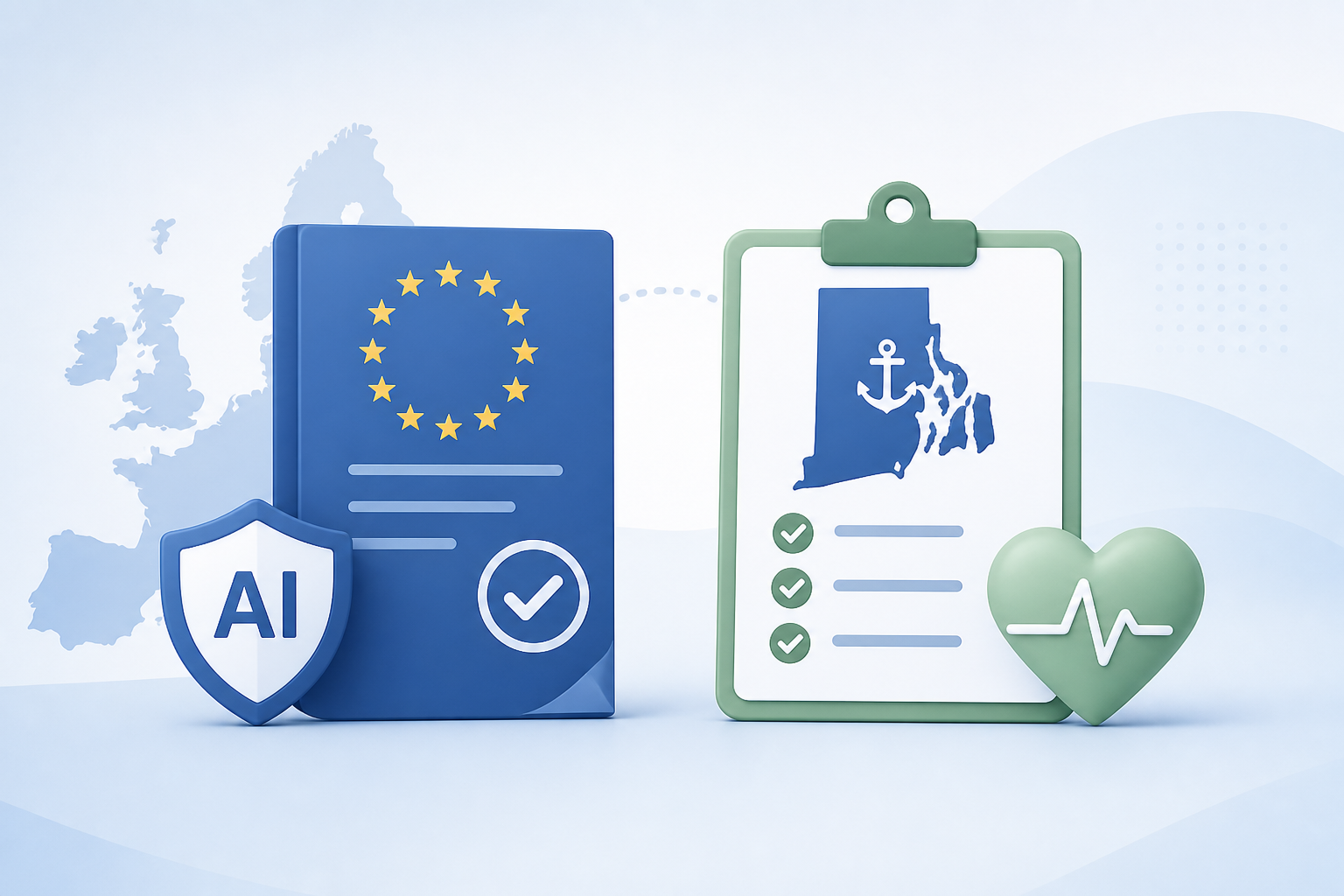
The EU Digital Omnibus (Regulation 2026/1744) simplifies AI Act compliance, easing the burden for healthcare and AI systems. Concurrently, Rhode Island has enacted three laws regulating AI in healthcare, emphasizing transparency and accountability, impacting biotech and healthtech sectors in compliance and patient engagement.
EU Digital Omnibus on AI: Simplification of the AI Act
Regulation (EU) 2026/1744 of the European Parliament and of the Council of 8 July 2026 amends Regulation (EU) 2024/1689 (the EU AI Act), Regulation (EU) 2018/1139 (aviation safety) and Regulation (EU) 2023/1230 (machinery) with the stated aim of simplifying harmonised AI rules. The European Parliament and Council acknowledged that the original AI Act's implementation requirements created disproportionate complexity for smaller operators and certain regulated sectors, and the Digital Omnibus seeks to address that by streamlining specific obligations. Healthtech and medtech developers should map the revised provisions against their existing AI governance frameworks to identify where updated procedures or documentation may be required.
United States: Rhode Island Regulates AI in Healthcare and Companion Tools
Rhode Island enacted three AI-focused statutes in June 2026, including the Use of Artificial Intelligence by Healthcare Providers Notification Act (S 2570), which imposes disclosure requirements on healthcare providers using AI tools in clinical settings. Additional statutes address AI companion tools and the use of AI in the provision of mental health services, reflecting legislative concern about patient vulnerability and the potential for AI-generated interactions to influence clinical or emotional outcomes. Organisations offering AI-assisted care-coordination, patient-engagement or mental-health platforms in the United States should review these statutes alongside existing federal frameworks to ensure notification and safeguard obligations are met.
FAQs
Our frequently questions
t amends the EU AI Act (Regulation (EU) 2024/1689) — along with the Machinery Regulation (EU) 2023/1230 and the aviation safety regulation (EU) 2018/1139 — to simplify certain implementation obligations that were seen as disproportionately burdensome, particularly for smaller operators. It doesn't dismantle the AI Act's risk-based framework; it revises specific procedural and documentation requirements, including aspects of conformity-assessment pathways relevant to high-risk systems.
Potentially, yes. If a company deploys or develops high-risk AI systems in these areas, the revised conformity-assessment and documentation rules under the amended regulations could change what's required on their product roadmap. Compliance teams should map the updated provisions against their existing AI governance framework to confirm which specific obligations shifted.
Rhode Island enacted three statutes in June 2026. The centerpiece, the Use of Artificial Intelligence by Healthcare Providers Notification Act (S 2570), requires healthcare providers to disclose their use of AI tools in clinical settings. The other two address AI companion tools and AI use in mental health service delivery, reflecting concern about patient vulnerability in these contexts.
They're a useful signal rather than a compliance shortcut. The transparency and accountability expectations echo principles familiar from European data protection law, but Rhode Island's requirements are distinct state statutes with their own notification and safeguard obligations. Any organization offering AI-assisted patient engagement, care coordination, or mental health tools to Rhode Island residents needs to review these specific statutes against its US compliance posture — GDPR alignment alone won't cover them.

Find out how iliomad can help your company.
Only visible in production

MR-001 CNIL: what clinical trial sponsors must know about French health data compliance
Understand MR-001 CNIL obligations for clinical trial sponsors in France, from Article 32 security requirements to breach notification and cross-border data transfers.
ICF Boilerplate and Open-Access Database Disclosures: What Clinical Trial Sponsors Must Know
Learn how US site ICF boilerplate on commercial products and open-access genetic databases affects sponsor data governance, Common Rule compliance and GDPR obligations.

iliomad Weekly Digest: DPO Conflicts, Bulk Data Rules, Healthcare Cyber Incidents and AI Transparency
This week: CNIL on DPO conflicts of interest, DOJ bulk data rule for life sciences, wave of healthcare ransomware attacks, Uber's €825m GDPR fine and AI disclosure demands.
