


Summary
Standard contractual clauses (SCCs) are crucial for data transfers in clinical trials under GDPR, ensuring compliance for countries lacking adequacy decisions. Understanding their role, particularly in relation to processor binding corporate rules (BCR-P), is essential for sponsors and CROs to navigate complex data flows effectively and maintain compliance with EDPB recommendations.
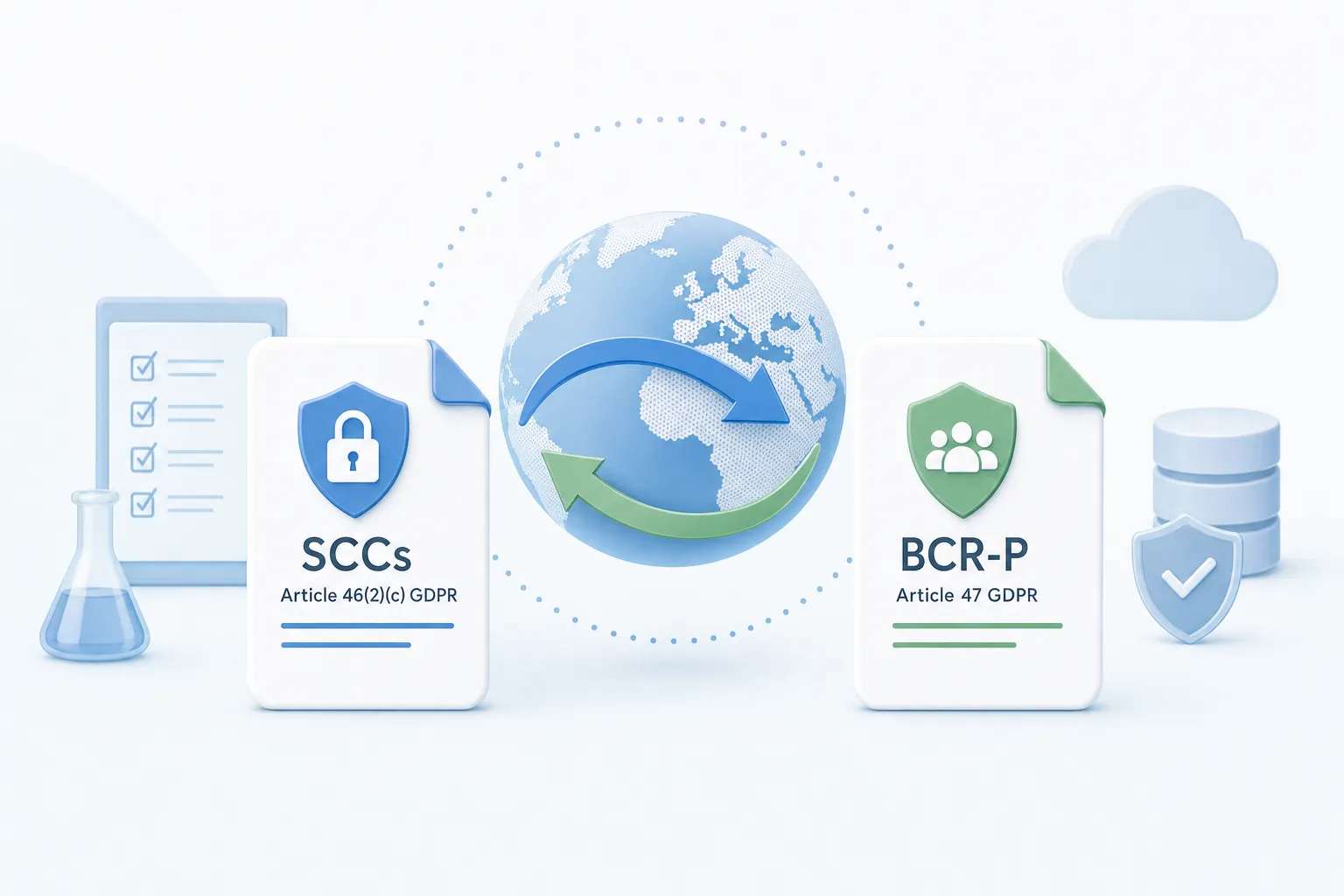
Standard contractual clauses (SCCs) in clinical trials are the Article 46(2)(c) GDPR contractual tool that legitimises sending trial data to a country outside the European Economic Area (EEA) that has no adequacy decision. The phrase causes confusion because recent German law uses the same words for an unrelated clinical trial agreement template. This explainer separates the two meanings, shows how transfer SCCs work for sponsors, CROs and vendors, and sets out when processor binding corporate rules (BCR-P) replace SCCs for intra-group flows under the EDPB's Recommendations 1/2026.
Key takeaways
- Standard contractual clauses (SCCs) in clinical trials are the Article 46(2)(c) GDPR transfer tool set by Commission Implementing Decision (EU) 2021/914, not Germany's national clinical trial agreement templates.
- Processor binding corporate rules (BCR-P) are intra-group rules under Article 47 GDPR, and once approved by a supervisory authority they replace SCCs for transfers between members of the same processor group.
- BCR-P cannot cover a direct transfer from an external sponsor-controller to a group processor in a third country, so SCCs or another Article 46 tool remain required for that flow.
- A transfer impact assessment and supplementary measures stay the data exporter's responsibility under both SCCs and BCR-P, independent of any approval.
- The EDPB lists clinical trials among the purposes for which third-country laws must be assessed, so CROs and vendors should review their CTA data protection clauses now.
The transfer-tool triage for clinical trials
Before choosing any instrument, resolve three questions in order. This triage keeps a multi-country trial inspection-ready and avoids applying the wrong tool to the wrong flow.
- Is personal data leaving the EEA? If trial data moves to a sponsor, CRO, laboratory or cloud vendor located in a third country, a Chapter V transfer mechanism is engaged. If it stays within the EEA or goes to an adequate country, no Article 46 tool is needed.
- Is there an adequacy decision or a derogation? An adequacy decision removes the need for an Article 46 tool. The Article 49 derogations are narrow and rarely suitable for the systematic, repeated transfers typical of clinical operations.
- Is the transfer intra-group or external? An external sponsor-to-vendor transfer points to transfer SCCs. A repeated intra-group processor-to-sub-processor flow inside a single CRO or vendor group is where BCR-P becomes relevant.
What do "SCCs" actually mean in clinical research?
In clinical research, "SCCs" carries two unrelated meanings, and only one concerns international transfers. The first is the GDPR transfer tool: the standardised clauses in Commission Implementing Decision (EU) 2021/914, adopted on 4 June 2021, which provide appropriate safeguards for exporting personal data to third countries. The second is a national contract template for the clinical trial agreement itself, which governs commercial terms rather than data export.
Under the 2021 Decision, the role of standard contractual clauses is limited to ensuring appropriate data protection safeguards for international transfers, and the parties remain free to embed those clauses in a wider contract such as a data processing agreement. That distinction matters: a clinical trial agreement can reference transfer SCCs, but the two instruments answer different legal questions. For the vocabulary, see our glossary entry on standard contractual clauses.
Focus: the example of Germany's StandVKlV
Germany's standardised clinical trial agreement clauses govern intellectual property, publication, liability and a data protection annex within the national clinical trial agreement. They are a domestic contracting framework, not an Article 46 transfer tool, and they do not legitimise exporting trial data outside the EEA. A sponsor using the German template still needs transfer SCCs or another mechanism for any third-country flow. Treat the two as separate documents and do not assume the German clauses apply outside Germany or to non-commercial investigator-initiated studies.
When is a GDPR transfer tool required in a clinical trial?
A transfer tool is required whenever trial personal data is made accessible to an entity in a third country that has no adequacy decision. Access counts as a transfer even without a copy being sent: remote monitoring from a third country, a global cloud platform, a central laboratory abroad or sponsor pharmacovigilance review can each trigger Chapter V of the GDPR.
Clinical data flows are rarely simple. A single multi-country study can involve a sponsor-controller, one or more CROs acting as processors, investigator sites, specialist vendors and their own sub-processors. Mapping these flows before selecting an instrument is the practical first step, which we cover in our guidance on cross-border data transfers in clinical trials and the DPO's role. Only once each leg of the flow is identified can the right tool be matched to it.
How do transfer SCCs work for sponsors, CROs and vendors?
Transfer SCCs work by binding the exporter and importer to a set of enforceable data protection obligations approved by the European Commission, using the module that matches the parties' roles. Decision (EU) 2021/914 offers modules for controller-to-controller, controller-to-processor and processor-to-processor relationships, so a sponsor-controller exporting to a third-country CRO-processor selects a different module from a CRO exporting onward to its own sub-processor.
Their strength is flexibility: any two parties can sign them, with no prior regulator approval, and incorporate them into a data processing agreement. Their limit is operational. Each new vendor, sub-processor or country adds a fresh contractual leg, and every leg must be assessed and papered separately. In a large programme this produces a sprawling web of bilateral clauses to maintain, update and audit. Our note on the CRO as a data processor under the GDPR explains how these roles map onto the SCC modules in practice.
Focus: the example of the CNIL and MR-001
In France, a clinical trial processing personal data must align with the CNIL reference methodology MR-001 to benefit from a simplified compliance route. MR-001 does not itself authorise international transfers, so a sponsor relying on it still layers an Article 46 tool, typically transfer SCCs, on top for any third-country flow. This illustrates the layering logic: a national methodology addresses lawfulness and documentation, while the transfer tool addresses export. The two operate together, not as substitutes.
What are processor binding corporate rules (BCR-P) and why do they suit intra-group CRO flows?
Processor binding corporate rules (BCR-P) are internal data protection rules that a group of companies acting as processors uses to transfer personal data to its own entities outside the EEA, approved by a supervisory authority under Article 47 GDPR. Once approved, they replace SCCs for those intra-group transfers, so a global CRO or technology vendor no longer signs separate clauses between its own group members.
The EDPB confirms that, pursuant to Article 46(2)(b) GDPR, BCR are a tool for providing appropriate safeguards for transfers to third countries without an adequate level of protection. A second feature reduces paperwork: a group member that has implemented BCR-P does not need to sign a sub-processing agreement with each sub-processor inside the BCR-P group, which satisfies the Article 28(4) GDPR requirement for those internal relationships.
There is a hard boundary. The EDPB states that BCR-P are not suitable to cover a direct transfer from an external controller to a processor member of the BCR-P group in a third country, and that a different Article 46 tool is required for such a transfer. In clinical terms, the sponsor-controller still needs SCCs with the CRO: BCR-P only governs what the CRO group then does internally. See our glossary entry on binding corporate rules for the underlying definition.
SCCs vs BCR-P: a decision view for clinical trial data transfers
SCCs and BCR-P solve different problems, so they are complementary rather than interchangeable. The table below frames the choice for a clinical trial setting.
<table><tr><th>Feature</th><th>Transfer SCCs (Decision 2021/914)</th><th>Processor BCR-P (Art. 47 GDPR)</th></tr><tr><td>Legal basis</td><td>Article 46(2)(c) GDPR</td><td>Articles 46(2)(b) and 47 GDPR</td></tr><tr><td>Typical trial use</td><td>Sponsor-controller to third-country CRO or vendor; CRO to external sub-processor</td><td>Transfers between members of one CRO or vendor group</td></tr><tr><td>Approval</td><td>None required before signing</td><td>Supervisory authority approval required</td></tr><tr><td>External sponsor-to-vendor transfer</td><td>Covered</td><td>Not covered, separate Article 46 tool needed</td></tr><tr><td>Intra-group sub-processing</td><td>Covered leg by leg</td><td>Covered, no separate sub-processing agreement between group members</td></tr><tr><td>Transfer impact assessment</td><td>Required</td><td>Still required per transfer</td></tr><tr><td>Setup effort</td><td>Lower per contract, higher in volume</td><td>Higher upfront, lower recurring internal admin</td></tr></table>A practical reading: BCR-P does not remove the sponsor's SCCs, it streamlines the vendor group's internal flows once in place.
What do EDPB Recommendations 1/2026 change for CROs and vendors?
The EDPB's Recommendations 1/2026 clarify the scope, structure and required content of BCR-P and the approval application, updating earlier guidance from the Article 29 Working Party. Following a public consultation, the EDPB adopted the final version in 2026, and the recommendations apply on publication of that final text.
Three points matter for life sciences data transfer tools. First, clinical trials are named explicitly among the purposes for which the assessment of third-country laws and practices must be carried out, so the clinical context is squarely in scope. Second, existing BCR-P holders and applicants must bring their rules into line, either during the approval process or, at the latest, as part of their annual update cycle (the EDPB points to the 2028 annual update as the latest deadline; verify the exact cut-off before relying on it). Third, the documents governing timelines and the lead authority process sit outside the recommendations themselves, so approval duration should not be assumed to be short.
For CROs and vendors, the operational consequence is a contractual review: confirm whether a group relies on, or is applying for, BCR-P, and reflect the updated requirements in vendor management and in the data transfer clauses of the clinical trial agreement. Our overview of data transfer compliance in clinical trials sets the wider context.
Transfer impact assessments: the step both tools still require
A transfer impact assessment (TIA) is the exporter's documented evaluation of whether the laws and practices of the destination country undermine the chosen safeguards, and it is required for SCCs and BCR-P alike. Neither instrument is self-sufficient: the EDPB confirms that the TIA and any supplementary measures remain the responsibility of the data exporter and controller for each transfer, independent of the BCR-P approval process.
The SCCs carry the same expectation. Decision (EU) 2021/914 makes clear that using the clauses does not exhaust the exporter's duty to verify that destination-country law does not prevent compliance. In practice, that means a documented TIA per third-country leg, with supplementary measures such as strong encryption, pseudonymisation or access controls where the assessment identifies a risk. Our glossary entry on the transfer impact assessment summarises the method.
Focus: the example of Turkey and VERBİS
Turkey illustrates why a tool plus a TIA is still not the whole picture. A sponsor running sites in Turkey must consider local registration and the Turkish transfer regime alongside the GDPR mechanism, as set out in our guide to VERBİS registration and standard contractual clauses in Turkey. The lesson generalises: the Article 46 tool is one layer, the TIA is another, and national formalities may add a third.
Practical checklist for sponsors and vendors
- Map every third-country access point in the trial, including remote monitoring, cloud hosting, central laboratories and sub-processors.
- For each external leg, confirm the correct SCC module and embed it in the data processing agreement and the clinical trial agreement data protection clauses.
- Ask each CRO and vendor group whether it holds, or is applying for, BCR-P, and request the approval status.
- Document a transfer impact assessment and supplementary measures for every third-country transfer, whichever tool applies.
- Diarise the BCR-P alignment deadline and factor it into contractual reviews and vendor reassessments.
How iliomad helps
iliomad implements clinical trial data transfer frameworks hands-on: mapping flows, selecting and papering the right Article 46 tool, running transfer impact assessments, and aligning CTA data protection clauses with the current EDPB position. We work with sponsors, CROs and vendors as outsourced DPO and as EU, UK and Swiss representatives, and our teams support CROs and clinical service providers and broader clinical trials data protection programmes, including contractual review. To pressure-test your SCCs and BCR-P position before your next study milestone, get in touch with iliomad.
FAQs
Our frequently questions
Yes — a transfer impact assessment (TIA) is required for both SCCs and BCR-P. Neither instrument is self-sufficient. The TIA is the data exporter's documented evaluation of whether the laws and practices of the destination country undermine the safeguards provided by the chosen transfer tool. The EDPB confirms that the TIA and any supplementary measures remain the responsibility of the data exporter and controller for each transfer, independent of the BCR-P approval process. Commission Implementing Decision (EU) 2021/914 makes the same expectation clear for SCCs: using the clauses does not exhaust the exporter's duty to verify that destination-country law does not prevent compliance. In practice, this means a documented TIA per third-country leg, with supplementary measures such as strong encryption, pseudonymisation or access controls where a risk is identified. For example, a sponsor running sites in Turkey must layer the Article 46 tool, a TIA, and local national formalities (such as VERBİS registration) — each addressing a separate layer of compliance.
The EDPB's Recommendations 1/2026 update and clarify the scope, structure and required content of BCR-P, replacing earlier Article 29 Working Party guidance. Three points are particularly relevant for life sciences. First, clinical trials are explicitly named among the purposes for which an assessment of third-country laws and practices must be carried out, putting the clinical context squarely in scope. Second, existing BCR-P holders and applicants must bring their rules into alignment — either during the approval process or, at the latest, as part of their annual update cycle (with 2028 cited as the latest deadline, though this should be verified). Third, approval timelines and the lead authority process sit outside the recommendations themselves, so approval duration should not be assumed to be short. For CROs and vendors, the practical consequence is a contractual review: confirm BCR-P status and reflect updated requirements in vendor management and in the data transfer clauses of the clinical trial agreement.
Processor binding corporate rules (BCR-P) are internal data protection rules that a group of companies acting as processors uses to transfer personal data between its own entities outside the EEA, approved by a supervisory authority under Article 47 GDPR. Once approved, BCR-P replace SCCs for those intra-group transfers, meaning a global CRO or technology vendor no longer needs to sign separate transfer clauses between its own group members. However, there is a hard boundary: BCR-P do not cover a direct transfer from an external sponsor-controller to a processor member of the BCR-P group in a third country. For that external leg, the sponsor still needs SCCs or another Article 46 tool. In short, BCR-P streamline what happens inside the vendor group; they do not remove the sponsor's obligation to put an Article 46 tool in place for its own transfers to that group.
Transfer SCCs work by binding the data exporter and importer to a set of enforceable data protection obligations approved by the European Commission, using the module that matches the parties' roles. Decision (EU) 2021/914 provides four modules: controller-to-controller, controller-to-processor, processor-to-processor, and processor-to-controller. For example, a sponsor-controller exporting to a third-country CRO-processor would use a different module than a CRO exporting onward to its own sub-processor. Their key strength is flexibility: any two parties can sign them without prior regulatory approval and embed them into a broader data processing agreement or clinical trial agreement. Their main limitation is operational — in a large programme, every new vendor, sub-processor or country adds a fresh contractual leg, each requiring its own assessment and documentation.
A GDPR transfer tool is required whenever trial personal data is made accessible to an entity located in a third country that has no adequacy decision with the EEA. Crucially, "access" counts as a transfer even if no copy is physically sent: remote monitoring from a third country, a global cloud platform, a central laboratory abroad, or sponsor pharmacovigilance review can each trigger Chapter V of the GDPR. Article 49 derogations exist but are narrow and rarely suitable for the systematic, repeated transfers typical of clinical operations. The practical first step is to map every data flow — across sponsors, CROs, investigator sites, specialist vendors and their sub-processors — before selecting the appropriate transfer instrument for each leg of the transfer.
In clinical trials, "SCCs" can refer to two unrelated things. The first — and most important for international data transfers — is the GDPR transfer tool: the standardised clauses set out in Commission Implementing Decision (EU) 2021/914, which provide appropriate safeguards for exporting personal data to third countries outside the EEA under Article 46(2)(c) GDPR. The second meaning is a national contract template (such as Germany's StandVKlV) that governs commercial terms like intellectual property, publication rights and liability within a clinical trial agreement. These two instruments answer completely different legal questions and must not be confused: the German template, for example, does not legitimise exporting trial data outside the EEA — a separate Article 46 transfer tool is still required for any third-country data flow.
Find out how iliomad can help your company.
Only visible in production
Cross-border data transfers in clinical trials: the DPO's role in choosing mechanisms and monitoring compliance
How the DPO advises on and monitors cross-border data transfers in clinical trials, from SCCs to transfer impact assessments across EEA, UK and Swiss law.

Weekly Privacy and Life Sciences Digest: Ransomware Surge, Biometric Guidance and AI Governance Developments (10 November 2026)
This week's digest covers the Vortex ransomware group targeting healthcare, AEPD biometric guidance, Saudi PDPL amendments, ICO special category updates and AI funding rounds.

CRO data processor: GDPR obligations, contracts and accountability in clinical trials
Understand how a CRO acts as a data processor under GDPR in clinical trials: key obligations, DPA requirements, liability and practical compliance steps.
