


Summary
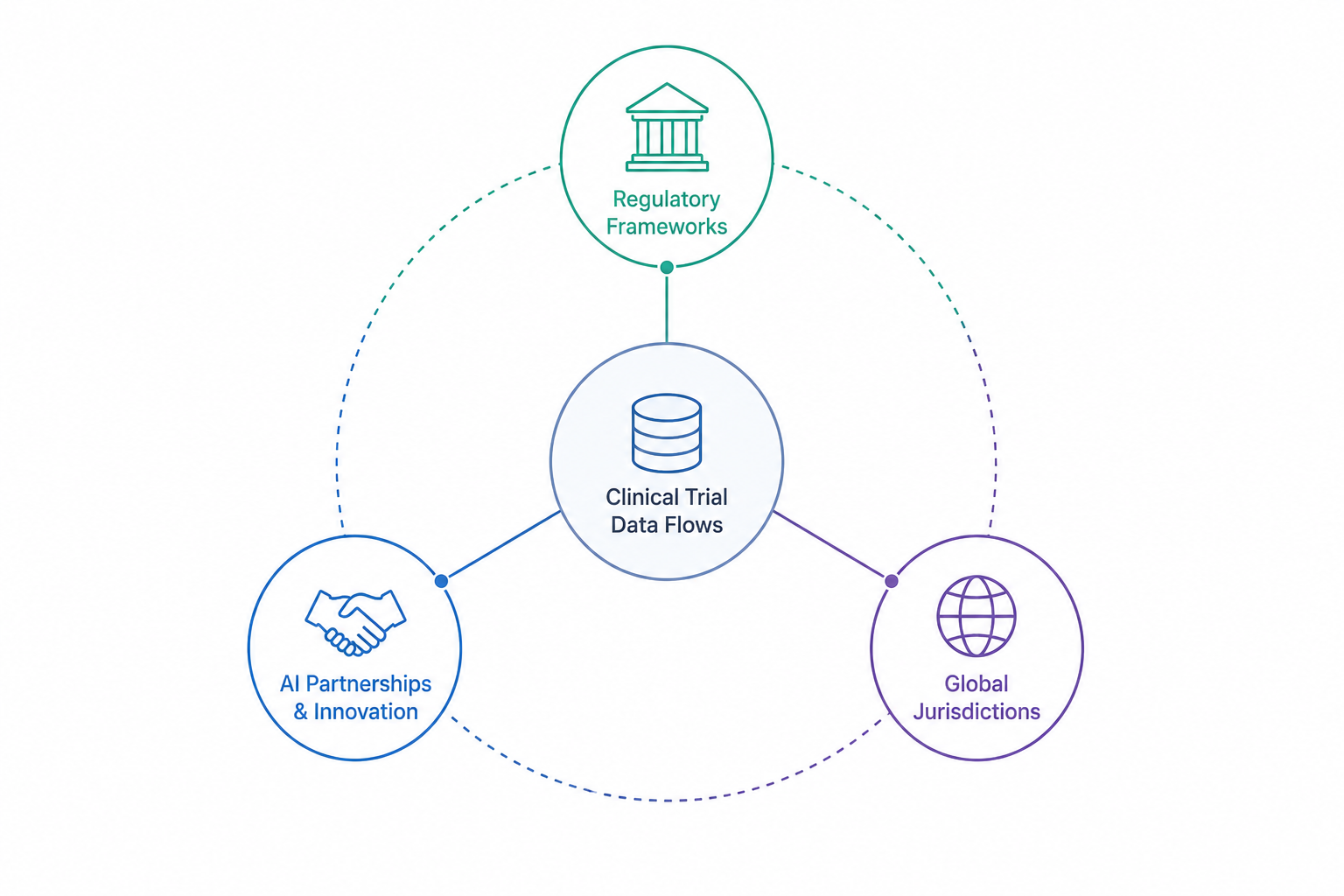
This week's developments confirm several converging pressures on life sciences and healthtech organisations: regulatory tightening of clinical research oversight in China, the practical limits of data protection enforcement against insolvent respondents, the acceleration of AI adoption in drug discovery with attendant data governance obligations, and a growing legislative focus on protecting minors from AI-related privacy harms.
1. Clinical Trial Safety, Transparency and Oversight
China Tightens Scrutiny of Investigator-Initiated Trials
China's National Medical Products Administration (NMPA), the country's primary medicines and devices regulator, has introduced heightened pre-approval scrutiny for investigator-initiated trials (IITs), meaning clinical studies designed and led by independent researchers rather than a commercial sponsor. Historically, IITs have been exempt from the same regulatory gateway applied to sponsor-led programmes, allowing China to build a reputation for rapid trial initiation. The NMPA's new measures follow mounting concerns about data quality and safety standards in this category of research, and they carry significant implications for international sponsors who rely on Chinese IIT data to support global submissions.
Child Death in Chinese Gene-Editing Trial Raises Transparency Concerns
HuidaGene, a Chinese biotech, was testing a CRISPR-based gene-editing therapy (a technique that uses molecular tools to alter specific DNA sequences) for Duchenne muscular dystrophy in paediatric patients. The company presented early two-patient data at a 2025 conference without clear evidence of therapeutic benefit, then went silent for 15 months, during which its chief executive and chief technology officer departed without public explanation. STAT News's investigation, which required months of repeated questioning, ultimately confirmed that a child participant had died during the trial. The case illustrates acute deficiencies in adverse event reporting obligations and the particular vulnerability of paediatric participants, whose informed consent protections demand the highest procedural rigour under both Chinese regulation and internationally recognised Good Clinical Practice (GCP) standards.
US Vaccine Schedule Overhaul Creates Protocol Uncertainty
President Trump signed an executive order on 10 August 2026 establishing what the administration terms "Gold Standard Childhood Vaccine Recommendations," which would reduce the federally recommended childhood immunisation schedule from 18 doses to 11 administered over an extended timeline. The order also calls for separating the combined measles-mumps-rubella (MMR) vaccine into three distinct single-antigen shots, a change immunology experts note would require years of clinical evaluation and regulatory review before implementation. For sponsors conducting paediatric vaccine trials that reference the US standard-of-care schedule as a comparator, this shift introduces immediate protocol uncertainty and may trigger material amendments requiring fresh ethics and regulatory approval.
2. Health Data Breaches and Enforcement
ICO Marks 23andMe Genetic Data Fine as Uncollectable
The UK Information Commissioner's Office (ICO), the supervisory authority responsible for enforcing the UK General Data Protection Regulation (UK GDPR) and the Data Protection Act 2018, has formally abandoned recovery of the £2.31 million penalty notice it issued against genetic testing company 23andMe in June 2025. That penalty related to a 2023 data breach that exposed the genetic and health information of more than 150,000 UK residents. The fine has been recorded as "not recoverable" on the ICO's public register following 23andMe's Chapter 11 bankruptcy proceedings in the United States. The outcome underscores a structural enforcement gap: regulatory fines issued against insolvent respondents may never produce financial redress for affected data subjects, and it raises questions about whether advance security deposit requirements or other mechanisms should be considered for data controllers handling special-category data such as genetic information.
Snowflake Campaign: Canadian Hacker Pleads Guilty
Connor Riley Moucka, a Canadian national, pleaded guilty on 6 August 2026 to multiple US federal charges including computer fraud and wire fraud arising from a 2024 extortion campaign that exploited stolen login credentials, many of which lacked multi-factor authentication (MFA), to access customer accounts on the Snowflake cloud data platform. The conspiracy affected more than 165 organisations and exposed sensitive data belonging to millions of individuals. The case is directly relevant to life sciences organisations: cloud-based data platforms are widely used for clinical trial data aggregation, and the absence of MFA on privileged accounts represents a basic control failure that regulators and data protection officers (DPOs) should treat as unacceptable for any processing of personal health data.
Ransom Cartel Operator Sentenced to 16 Years
Maksim Silnikau, a 40-year-old Belarusian national extradited from Spain via Poland in 2024, received a 16-year US federal prison sentence on 5 August 2026 following conviction for conspiracy, wire fraud and aggravated identity theft. Silnikau operated the Ransom Cartel ransomware-as-a-service scheme (a criminal model that licences ransomware tools to third-party attackers in exchange for a share of extortion proceeds) which targeted at least 18 organisations across the US and abroad between 2021 and 2023. The sentencing reinforces the seriousness with which US federal courts are approaching healthcare-sector cybercrime and signals that ransomware operators face meaningful custodial risk even when operating across multiple jurisdictions.
Unlimited Technology Systems Breach Exposes 3.8 Million Oncology Patients
Unlimited Technology Systems, a Montgomery, Ohio-based provider of financial and revenue-cycle management technology to more than 4,500 oncology offices and 6,500 specialty providers, disclosed to the US Department of Health and Human Services (HHS) in late July 2026 that attackers accessed one of its commercial data centres between 5 and 10 October 2025. The breach affects approximately 3,803,750 individuals and exposed names, addresses, phone numbers, email addresses and clinical data. The nine-month gap between the intrusion and the HHS disclosure is concerning under both the Health Insurance Portability and Accountability Act (HIPAA), the US federal law governing the privacy and security of protected health information, and broader expectations of timely notification to affected individuals.
Updoc Telehealth Breach Exposes Australian Patient Contact Data
Updoc, an Australian telehealth platform that has served more than one million patients, confirmed on 7 August 2026 that an external system supporting its operations was accessed without authorisation on 31 July 2026. The exposed data was limited to contact information such as names, email addresses and postal addresses, with Updoc confirming that health records, financial data and payment details were not compromised and that no access to clinical systems occurred. Australian organisations handling health data are subject to the Privacy Act 1988 (Cth) and the Australian Privacy Principles (APPs), and the incident demonstrates the ongoing risk posed by third-party system dependencies even where core clinical data repositories remain secure.
Dutch Regulator Warns on Period-Tracking App Privacy
The Autoriteit Persoonsgegevens (AP), the Dutch national data protection authority, issued a public warning on 4 August 2026 about privacy risks in menstruation and fertility-tracking applications. The AP confirmed that cycle and reproductive health data qualifies as "special category" personal data under Article 9 of the General Data Protection Regulation (GDPR), the EU Regulation 2016/679 governing the processing of personal data in the European Economic Area, and therefore requires explicit, informed consent before collection or sharing. The AP found that a significant proportion of apps reviewed were sharing such data with third parties without adequate legal basis. Sponsors conducting decentralised or hybrid clinical trials that incorporate consumer health-tracking applications as a data collection modality should treat this warning as confirmation that a Data Protection Impact Assessment (DPIA), a structured risk analysis mandated by GDPR Article 35 for high-risk processing, is required before deployment.
US Government Hospital Emergency Data Collection Draws Privacy Challenge
The US Consumer Product Safety Commission's NEISS Remodel (NEISS-R) initiative aims to modernise the 50-year-old National Electronic Injury Surveillance System by expanding automated identifiable patient data collection from approximately 70 to more than 100 hospital emergency departments across all US states by the end of 2026, using Kansas-based contractor Konza Health under a $15.9 million contract. The system would transmit identifiable patient data including names and addresses without explicit patient consent, drawing criticism from privacy advocates who argue the collection exceeds the programme's original statutory scope. Health systems asked to participate in NEISS-R should conduct careful legal analysis of their obligations under HIPAA and applicable state privacy laws before connecting systems to the programme.
3. AI in Drug Discovery and Clinical Settings
Novo Nordisk and AWS Launch Strategic AI Drug Discovery Partnership
On 10 August 2026, Novo Nordisk and Amazon Web Services (AWS) announced a multi-year strategic alliance under which AWS becomes Novo Nordisk's preferred cloud infrastructure and artificial intelligence partner for drug discovery. The partnership centres on a new London-based co-innovation hub pairing AWS engineers with Novo Nordisk researchers, and will use Amazon Bio Discovery, Amazon Bedrock and Bedrock AgentCore to identify drug targets and design candidate molecules. From a data governance perspective, the London location is relevant: data processed in the hub may be subject to both UK GDPR and, depending on data flows, EU GDPR, meaning that transfer mechanisms such as Standard Contractual Clauses (SCCs) and an accompanying Transfer Impact Assessment (TIA) will be required for any personal data moving between the hub and non-adequate third countries. Sponsors and DPOs in the life sciences sector should monitor how Novo Nordisk publishes its AI governance framework for this arrangement, as it will likely serve as a reference model.
US Federal Regulators Hold Closed-Door Clinical AI Meetings
STAT News revealed that the US Food and Drug Administration (FDA), Centers for Medicare and Medicaid Services (CMS) and Department of Health and Human Services (HHS) held a previously undisclosed "clinical AI demo day" at FDA's White Oak headquarters on 8 July 2026, convening representatives from ten AI companies including Anthropic, Microsoft AI, Amazon One Medical and Hippocratic AI. Many of the participating companies are backed by major venture capital firms. The closed nature of the event has prompted transparency concerns, particularly given that the FDA is responsible for regulating AI-enabled medical devices and software as a medical device (SaMD) under the Federal Food, Drug and Cosmetic Act. Life sciences organisations developing or procuring clinical AI tools should note that regulatory engagement on this topic is progressing rapidly at the agency level, even where formal public guidance has not yet been published.
4. AI Governance and Child Safety Legislation
US Senate Commerce Committee Advances AI Child-Safety Bills
The US Senate Commerce Committee voted on 5 August 2026 to advance the long-pending Kids Online Safety Act (S.1748, KOSA) alongside a suite of AI-specific child-safety measures. These include the Youth AI Privacy Act (S.4199), which bars targeted advertising to minors on AI chatbot platforms and limits retention periods for minors' interaction data, and the CHATBOT Act (S.4407), which would require verifiable parental consent before minors may interact with AI conversational agents. For healthtech developers whose products include AI chatbot functionality accessible to under-18 users, passage of these measures would impose meaningful data minimisation and consent obligations that sit alongside existing requirements under the Children's Online Privacy Protection Act (COPPA).
China Publishes Wave of AI and Data Protection Measures
The International Association of Privacy Professionals (IAPP) reported on 6 August 2026 that China has introduced five significant regulatory developments in rapid succession. Anthropomorphic AI rules that took effect on 15 July 2026 require risk assessments, ethics reviews, content monitoring and specific safeguards for minors and older users. New financial-AI guidelines require risk-committee approval and regulatory filing for high-risk AI deployments by banks and insurers. A draft anti-cyber-violence law represents China's first explicit legislative response to online harassment. Taken together, these measures signal that China is assembling a comprehensive AI governance architecture that will affect international organisations operating in or partnering with Chinese entities, including those conducting clinical research or managing health data in-country.
Serbia Publishes Draft Data Protection Law for Consultation
Serbia has published for public consultation a draft Law on Personal Data Protection that would substantially restructure the country's current framework. The draft adds new provisions on artificial intelligence, video surveillance, data transfers and biometric identification, bringing Serbian law closer in structure to the GDPR. For sponsors running clinical trials at Serbian investigator sites, the draft's provisions on data transfers and biometric data are particularly relevant, because they may affect the legal mechanisms required to move participant data from Serbian sites to sponsors or contract research organisations (CROs) established in the European Economic Area or third countries.
5. Digital Health Interoperability and Patient Data Standards
US Senators Introduce MATCH IT Act on Patient Record Matching
Senators Mark Warner and Jim Banks introduced the Patient Matching and Transparency in Certified Health IT (MATCH IT) Act in the US Senate on 5 August 2026. The bill would require that certified electronic health record (EHR) technology adopt uniform demographic data standards to reduce patient-matching errors, which occur when a patient's records across different health systems cannot be reliably linked because of inconsistent data entry conventions. Poor patient matching is a longstanding data-quality and interoperability problem linked to medical errors and duplicated care. For clinical trial sponsors using EHR data as a source for real-world evidence or patient recruitment, passage of the MATCH IT Act would improve the reliability of source data verification and reduce the risk of errors in subject identification.
FAQs
Our frequently questions
The key risks include tighter clinical trial oversight, growing scrutiny of health data security, new AI governance requirements and stronger protections for children using AI products. Organisations operating internationally should pay particular attention to clinical trial transparency, cross border data transfers, cybersecurity controls and emerging AI specific compliance obligations.
International sponsors relying on investigator initiated trial data from China may face greater scrutiny around data quality, participant safety and regulatory compliance. Sponsors should assess whether Chinese trial data meets internationally recognised Good Clinical Practice standards and whether additional documentation or monitoring may be required for global regulatory submissions.
The breaches reinforce the importance of basic security controls such as multi factor authentication, third party risk management, rapid incident detection and timely breach notification. Organisations processing health or genetic data should also ensure that vendors handling sensitive information are subject to appropriate contractual, technical and organisational safeguards.
AI drug discovery partnerships may involve large scale processing and international transfers of research or personal data. Companies should map data flows, identify the appropriate lawful basis, conduct Data Protection Impact Assessments where required and implement valid transfer mechanisms when personal data moves to countries without an adequacy decision.
Regulators and legislators are increasingly concerned about how AI platforms collect, retain and use children’s personal data. Proposed US legislation could introduce stricter requirements around parental consent, targeted advertising and data retention, while organisations operating in other jurisdictions must also consider existing children’s privacy and data protection rules.
Organisations should review clinical trial governance procedures, reassess cybersecurity controls, evaluate third party and cloud provider risks, document AI governance processes and check whether current international data transfer arrangements remain appropriate. Companies using consumer health apps, AI tools or sensitive patient data should also confirm whether updated DPIAs and privacy notices are required.

Find out how iliomad can help your company.
Only visible in production
Vendor clinical trials: audit trails, logging gaps and sub-processor obligations
Understand vendor GDPR obligations in clinical trials, including audit-trail requirements, sub-processor controls and breach notification under Articles 28, 33 and 34.
Clinical studies and disability data governance: what life sciences sponsors must track
Learn how proposed cuts to US federal health surveys affect clinical studies, real-world evidence and cross-border data benchmarking for life sciences sponsors.
iliomad Weekly Digest: AI in Clinical Research, EU Health Data Rules, Cybersecurity and Regulatory Enforcement
This week: ARPA-H SURPASS trials programme, EHDS metadata rules, EDPB fine methodology, Citrix zero-days, Labcorp settlement and AI health-data governance.
