


Summary
Article 10 of the AI Act, along with GDPR and the EHDS, outlines the requirements for sourcing and processing training data for medical AI in the EU. It emphasizes the need for lawful data governance and documentation practices to ensure compliance, especially in the context of high-risk AI systems used in healthcare.
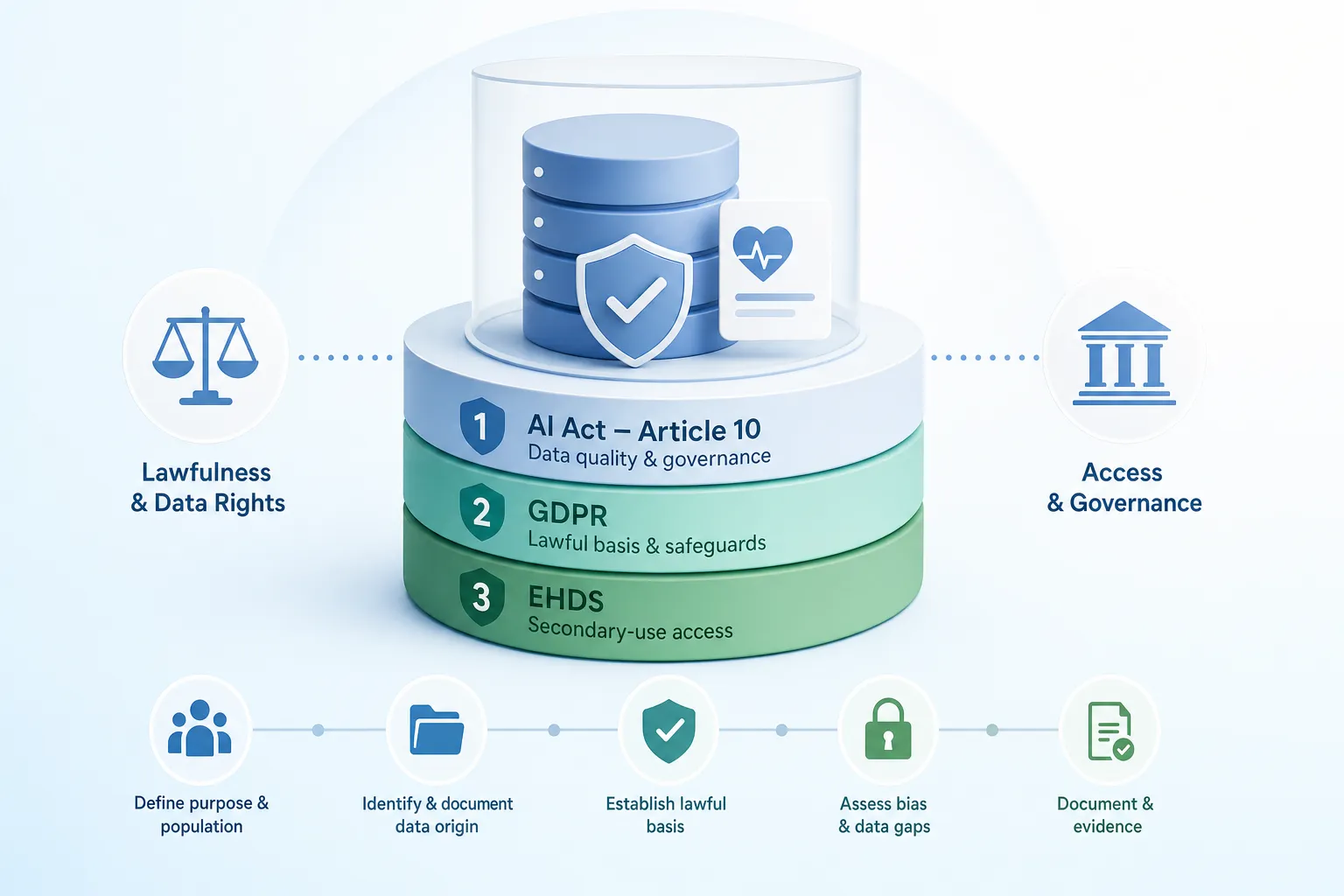
Article 10 of the AI Act sets the data governance and data quality rules that high-risk AI systems must meet when they are trained on data. For medical AI built in the EU, Article 10 is only the first of three layers that decide whether a training dataset can be sourced defensibly. It fixes what a dataset must look like, but it does not make the sourcing lawful. GDPR decides the legal basis for processing health data, and the European Health Data Space (EHDS) provides an emerging route to access regulated health datasets for secondary use. Reading the three layers together is what keeps a dataset defensible when a notified body or a regulator asks where the data came from.
Key takeaways
- Article 10 of the AI Act governs data quality and data governance for high-risk AI systems, but it does not provide a lawful basis to process personal health data.
- GDPR decides whether medical training data may be processed lawfully, through a legal basis under Article 6, a special-category condition under Article 9 and the research safeguards of Article 89.
- The EHDS creates a secondary-use pathway for health data that remains subject to GDPR, not a replacement for it.
- Medical AI that qualifies as a medical device and requires third-party conformity assessment is generally treated as high-risk, which triggers Article 10 across training, validation and testing datasets.
- Decisions on data origin, representativeness and documentation taken at sourcing cascade directly into Article 10 defensibility at conformity assessment.
What does Article 10 of the AI Act require for medical AI?
Article 10 of the AI Act requires providers of high-risk AI systems trained on data to develop them using training, validation and testing datasets that meet defined data governance and data quality criteria. A high-risk AI system is an AI system that falls within one of the categories the AI Act treats as posing significant risk to health, safety or fundamental rights. Medical AI reaches this threshold in most cases: an AI system that qualifies as a medical device under the Medical Device Regulation (MDR) or the In Vitro Diagnostic Regulation (IVDR) and requires third-party conformity assessment is generally treated as high-risk, which brings Article 10 into play.
Article 10(2) sets out the data governance and management practices that must be applied to each dataset. Read for a clinical use case, they require you to document and justify:
- the relevant design choices behind the dataset;
- the data collection process and the origin of the data;
- the data preparation operations, such as annotation, labelling, cleaning, updating, enrichment and aggregation;
- the assumptions made, in particular about what the data is supposed to measure and represent;
- an assessment of the availability, quantity and suitability of the datasets;
- an examination of possible biases likely to affect health, safety or fundamental rights;
- measures to detect, prevent and mitigate those biases;
- the identification of relevant data gaps or shortcomings and how they can be addressed.
Representativeness is where this becomes concrete for medical AI. A dataset must be representative of the intended purpose, so a diagnostic model intended for a broad patient population cannot be trained only on a narrow cohort from a single site without documenting that limitation. Article 10 also recognises that detecting and correcting bias can require processing special categories of personal data, for example data revealing health or ethnicity, and permits this only under strict and exceptional conditions. A reform package known as the Digital Omnibus has been reported to relocate this special-category provision within the AI Act. Confirm the current consolidated text and the exact article numbering through the official sources before relying on it, because the wording is under revision. iliomad maintains an AI Act regulation and guidelines page that tracks these changes for life sciences teams.
How does GDPR decide whether your training data is lawful?
Article 10 tells you what a dataset must look like. It does not authorise you to process the personal data inside it. That authorisation comes from GDPR. Health data is a special category of personal data under Article 9(1) GDPR, so its processing is prohibited unless one of the conditions in Article 9(2) applies, on top of a lawful basis under Article 6(1).
For AI training built on clinical or real-world data, the usual routes are scientific research under Article 9(2)(j) combined with the safeguards of Article 89, or explicit consent under Article 9(2)(a). Article 89 GDPR requires appropriate safeguards for processing carried out for scientific research purposes, such as data minimisation and pseudonymisation, so that the rights of data subjects are protected. Our reading is simple: Article 10 quality and Article 9 or Article 89 lawfulness are separate questions, and a dataset can satisfy one while failing the other. We cover the research route in detail in our analysis of GDPR Article 89 and clinical research.
Focus: the example of France and the CNIL
In France, the CNIL operates reference methodologies (the Methodologies de Reference, such as MR-001) and a health data warehouse framework that structure how health data may be reused for research. A dataset drawn from a French source without the right authorisation or methodology compliance can be accurate and representative for the purposes of Article 10 and still unlawful under GDPR. The practical consequence is that the lawful basis has to be settled at the source, before the data is curated into a training set, not reconstructed afterwards.
What is the EHDS secondary-use pathway, and when will it apply?
The EHDS is a Regulation that creates a European framework for access to and reuse of electronic health data. For AI developers, its secondary-use pathway is the emerging legal route to access regulated health datasets held by hospitals, registries and other data holders, through national health data access bodies. The EHDS aims to improve natural persons' access to and control over their personal electronic health data and to enable reuse for purposes such as research, innovation and regulatory activities.
Crucially, the EHDS does not replace GDPR. The processing of personal electronic health data remains subject to Regulation (EU) 2016/679. The secondary-use provisions are being phased in, and the governance bodies and permitted-purpose rules are still being established at national level. Confirm the application dates and the list of permitted purposes against the operative articles before you build a sourcing plan around the EHDS. For the wider interaction between these regimes, see our overview of medical trials, AI, GDPR and the EHDS.
How do the three layers interact before you source or curate data?
The three layers answer three different questions, and you have to pass all three to source data defensibly. We call this the three-layer sourcing test.
<table><tr><th>Layer</th><th>Instrument</th><th>Question it answers</th><th>Consequence if ignored</th></tr><tr><td>1</td><td>AI Act Article 10</td><td>Is the dataset of the right quality, origin and representativeness for the intended purpose?</td><td>The high-risk AI system fails conformity assessment on data governance.</td></tr><tr><td>2</td><td>GDPR Articles 6, 9 and 89</td><td>Is the processing of this personal health data lawful?</td><td>The dataset is unlawful at source, regardless of its quality.</td></tr><tr><td>3</td><td>EHDS secondary use</td><td>Is there a permitted route to access regulated health data from data holders?</td><td>Access is refused or the reuse falls outside the permitted purpose.</td></tr></table>Applied in order, the test runs like this:
- Define the intended purpose and the target population, because Article 10 representativeness is judged against them.
- Identify every data source and its origin, and record it, because origin is both an Article 10 duty and a GDPR lawfulness question.
- Fix the GDPR legal basis and the Article 9 condition for each source before curation begins.
- Where you need regulated datasets you do not hold, check whether the EHDS secondary-use pathway or a national mechanism applies.
- Document the bias examination, the gaps and the mitigations, so the Article 10 file is ready for conformity assessment.
Where does medical AI training data come from, and what breaks compliance?
Medical AI training data typically comes from clinical trials, disease registries and real-world data, health data holders accessible through the EHDS, licensed third-party datasets and synthetic data. Each source carries a different lawfulness profile, and the sourcing choice cascades into Article 10 defensibility.
Compliance usually breaks in three ways. First, the data origin is undocumented, so Article 10(2)(b) cannot be satisfied and GDPR lawfulness cannot be demonstrated. Second, the lawful basis at the source does not cover AI training as a further purpose, which is a frequent problem with data first collected for care or for a specific trial. Third, the dataset is accurate but not representative of the intended-use population, which undermines both the clinical claim and Article 10.
Focus: the example of the EMA
European regulators expect the data behind a medicinal product or a device to be traceable and of documented quality. There is no formal EMA certified dataset label. When a vendor markets EMA compliant medical datasets, treat that as a claim to verify, not a guarantee: ask for the data origin, the lawful basis, the annotation methodology and the documentation that would survive a conformity assessment.
Focus: the example of the US FDA
Teams building for both the EU and the US face a second set of expectations. The FDA examines whether real-world imaging or annotation data is representative of the intended-use population and fit for the claimed indication. As with the EMA, no vendor can supply a dataset that is FDA compliant by label alone. Regulatory-grade, in practice, means documented origin, representativeness, annotation quality and the ability to demonstrate all three, which is exactly what Article 10 also asks for. A single, well-governed dataset file can serve both regimes.
How iliomad helps
iliomad are regulatory-compliance and data-protection practitioners for life sciences. We help product, data and compliance teams build the three-layer file that medical AI needs: the Article 10 data governance documentation, the GDPR lawful basis and research safeguards, and the EHDS or national access route, aligned so they reinforce rather than contradict one another. We support providers and deployers of high-risk medical AI through our AI compliance services and our work with healthtech, medtech and AI diagnostics teams. To pressure-test your training-data sourcing before you commit to a vendor or a dataset, get in touch with iliomad.
FAQs
Our frequently questions
Yes. Teams building medical AI for both the EU and the US will find significant overlap in what regulators expect. The EU requires documented data origin, representativeness, annotation quality, and bias mitigation under Article 10 of the AI Act. The US FDA similarly examines whether real-world or annotation data is representative of the intended-use population and fit for the claimed indication. In both regimes, no vendor can supply a dataset that is "compliant by label alone" — regulatory-grade means documented origin, representativeness, and annotation quality with the ability to demonstrate all three. A single, well-governed dataset file that meets these standards can therefore serve both regulatory frameworks, reducing duplication of effort for international teams.
Compliance with medical AI training data requirements typically breaks down in three key ways. First, the data origin is undocumented, making it impossible to satisfy Article 10(2)(b) or demonstrate GDPR lawfulness. Second, the lawful basis at the source does not cover AI training as a further processing purpose — a frequent issue when data was originally collected for patient care or a specific clinical trial. Third, the dataset may be accurate but not representative of the intended-use population, which undermines both the clinical claim and Article 10 requirements. These issues must be addressed at the point of sourcing, before data is curated into a training set, as they cannot easily be reconstructed after the fact.
The three-layer sourcing test ensures that medical AI training data is defensible across all applicable regulatory frameworks. The three layers answer three separate questions: (1) Article 10 of the AI Act — does the dataset meet data quality and governance requirements? (2) GDPR — is there a lawful basis and a valid Article 9 condition for processing the health data? (3) EHDS — if regulated datasets are needed, is the appropriate access pathway in place? Applied in order, teams should define the intended purpose and target population, identify and record every data source and its origin, fix the GDPR legal basis before curation begins, check whether the EHDS or a national mechanism applies, and then document bias examinations, gaps, and mitigations for the conformity assessment file.
The European Health Data Space (EHDS) is a Regulation that creates a European framework for accessing and reusing electronic health data. For AI developers, its secondary-use pathway provides an emerging legal route to access regulated health datasets held by hospitals, registries, and other data holders through national health data access bodies. However, the EHDS does not replace GDPR — the processing of personal electronic health data remains subject to GDPR. The EHDS should be understood as an additional access route that sits alongside GDPR obligations, not as a replacement for them. Developers must still satisfy GDPR requirements even when using the EHDS pathway.
No. Article 10 governs what a dataset must look like in terms of quality and governance, but it does not provide a lawful basis to process personal health data. That authorisation comes from GDPR. Health data is a special category of personal data under Article 9(1) GDPR, meaning its processing is prohibited unless one of the conditions in Article 9(2) applies — such as scientific research under Article 9(2)(j) combined with the safeguards of Article 89, or explicit consent under Article 9(2)(a) — on top of a lawful basis under Article 6(1). A dataset can satisfy Article 10 quality requirements while still being unlawful under GDPR, so both must be addressed independently.
Article 10 of the AI Act requires providers of high-risk AI systems to develop them using training, validation, and testing datasets that meet defined data governance and data quality criteria. Specifically, providers must document and justify their design choices, data collection processes and origins, data preparation operations (such as annotation, labelling, and cleaning), assumptions about what the data measures, an assessment of dataset availability and suitability, an examination of possible biases affecting health or safety, measures to mitigate those biases, and any identified data gaps. Representativeness is a key requirement — for example, a diagnostic model intended for a broad patient population cannot be trained solely on a narrow cohort from a single site without documenting that limitation.
No vendor can supply a dataset that is EMA or FDA compliant by label alone — there is no formal EMA certified dataset designation. When a vendor markets "EMA compliant" or "FDA compliant" medical datasets, this should be treated as a claim to verify, not a guarantee. Both the EMA and the FDA expect training data to be traceable, representative of the intended-use population, and of documented quality. In practice, regulatory-grade means documented data origin, representativeness, annotation methodology, and the ability to demonstrate all three in a way that would survive a conformity assessment. Notably, the documentation requirements of EU AI Act Article 10 and those expected by the FDA are closely aligned, meaning a single, well-governed dataset file can serve both regulatory regimes if properly prepared from the outset.
Compliance with medical AI training data requirements typically breaks down in three main ways. First, the data origin is undocumented, making it impossible to satisfy Article 10(2)(b) of the AI Act or demonstrate GDPR lawfulness. Second, the lawful basis at the source does not cover AI training as a further purpose — a frequent problem with data originally collected for patient care or for a specific clinical trial, where the original consent or legal basis does not extend to AI model development. Third, the dataset may be accurate but not representative of the intended-use population, which undermines both the clinical claim and Article 10 defensibility. These failures can surface during conformity assessment and cannot easily be corrected after data curation has begun.
Medical AI training data in the EU must pass three distinct compliance layers. First, the AI Act Article 10 asks whether the dataset is of the right quality, origin, and representativeness for the intended purpose — failure here means the high-risk AI system fails conformity assessment on data governance. Second, GDPR Articles 6, 9, and 89 ask whether processing of the personal health data is lawful — ignoring this means the dataset is unlawful at source regardless of its quality. Third, the EHDS secondary-use framework asks whether there is a permitted route to access regulated health data from data holders — without this, access may be refused or fall outside permitted purposes. All three layers must be satisfied, and the lawful basis under GDPR must be established at the source before data is curated into a training set, not reconstructed afterwards.
The European Health Data Space (EHDS) is an EU Regulation that creates a framework for accessing and reusing electronic health data held by hospitals, registries, and other data holders through national health data access bodies. For AI developers, its secondary-use pathway is an emerging legal route to access regulated health datasets for purposes such as research, innovation, and regulatory activities. Critically, the EHDS does not replace GDPR — the processing of personal electronic health data remains subject to Regulation (EU) 2016/679. The EHDS secondary-use provisions are still being phased in, and governance bodies and permitted-purpose rules are being established at national level. Teams should verify current application dates and permitted purposes against the operative articles before building a sourcing plan around the EHDS.
No. Article 10 of the AI Act governs data quality and data governance for high-risk AI systems, but it does not provide a lawful basis to process personal health data. That authorisation comes from the GDPR. Since health data is a special category of personal data under Article 9(1) GDPR, its processing is prohibited unless one of the conditions in Article 9(2) applies — on top of a lawful basis under Article 6(1). For AI training built on clinical or real-world data, the typical routes are scientific research under Article 9(2)(j) combined with the safeguards of Article 89, or explicit consent under Article 9(2)(a). A dataset can satisfy Article 10 quality requirements while still being unlawful under GDPR — both layers must be passed independently.
Article 10 of the AI Act requires providers of high-risk AI systems to develop them using training, validation, and testing datasets that meet defined data governance and data quality criteria. For medical AI, this means documenting and justifying the design choices behind the dataset, the data collection process and origin, data preparation operations (such as annotation, labelling, and cleaning), assumptions about what the data measures, an assessment of dataset availability and suitability, an examination of possible biases affecting health or fundamental rights, measures to mitigate those biases, and any identified data gaps. Medical AI that qualifies as a medical device under the MDR or IVDR and requires third-party conformity assessment is generally treated as high-risk, triggering Article 10 across all datasets used.
Find out how iliomad can help your company.
Only visible in production
CTA data protection clauses and the new right to health data traceability
How the EHDS Regulation and the AEPD 2026 decision reshape CTA data protection clauses on health data access and traceability before March 2027.

SCCs Clinical Trial Sites: Why Spanish Sites Require Full SCC Embedding in CTAs
Spanish clinical trial sites rarely accept SCCs by reference. Learn why full SCC embedding in CTAs is required and how to avoid operational delays.

Weekly Privacy and Health-Tech Digest: AI Funding, HIPAA Reform, Data Breaches and Cyber Resilience (17 November 2026)
This week: Isomorphic Labs $5B round, HIPAA Privacy Rule final rule, AI in healthcare governance, EU Cyber Resilience Act guidance, EDPB on onward transfer clauses and multiple US healthcare data breaches.
