


Summary
Spanish clinical trial sites require the full embedding of Standard Contractual Clauses (SCCs) in Clinical Trial Agreements (CTAs) due to legal and operational reasons. Incorporating SCCs by reference leads to delays and complications in site activation, as the complete contractual terms must be included to meet regulatory requirements and institutional governance.
Spanish clinical trial sites consistently decline to accept Standard Contractual Clauses incorporated by reference alone. Sponsors and contract research organisations (CROs) that rely on a hyperlink or a short contractual recital pointing to an external SCC document face significant delays in site activation. Embedding the full SCC text directly within the Clinical Trial Agreement (CTA) is the operationally sound and legally compliant approach for trials conducted in Spain.
What Are SCCs and Why Do They Apply to Clinical Trial Sites?
Standard Contractual Clauses (SCCs) are pre-approved contractual mechanisms adopted by the European Commission under Article 46(2)(c) of Regulation (EU) 2016/679 (the GDPR) that allow personal data to be transferred from the European Economic Area to third countries without requiring a separate adequacy decision. In a clinical trial context, SCCs become necessary whenever a sponsor, CRO or data processor established outside the EEA receives personal data originating from EEA trial participants, including pseudonymised health data, genomic data or safety narratives.
Under the EU Clinical Trials Regulation 536/2014 (the EU CTR), the sponsor bears ultimate responsibility for the lawfulness of all data processing activities across the trial. Where the sponsor is located in a third country, or where it transfers data to affiliates or service providers outside the EEA, the GDPR's Chapter V restrictions apply in full. The Commission's current SCCs, adopted by Commission Implementing Decision (EU) 2021/914 of 4 June 2021, replaced the earlier 2001 and 2010 sets and introduced a modular structure covering four transfer scenarios, including controller-to-processor and processor-to-processor flows that are common in multi-site trials.
Why Do Spanish Sites Refuse SCCs Incorporated by Reference?
Spanish hospital ethics committees and legal departments require the complete contractual text to be present within the CTA itself, because Spanish institutional review processes do not permit external documents to vary the agreed terms after signature.
The Spanish Data Protection Authority, the Agencia Española de Protección de Datos (AEPD), has consistently emphasised that contractual safeguards under Article 46 GDPR must be verifiable and enforceable at the point of execution. When SCCs are incorporated only by reference, the site's legal counsel cannot confirm, without additional enquiry, which SCC module applies, which optional clauses have been selected and whether the governing law clause is compatible with Spanish procedural rules. This creates a document-completeness objection that is entirely separate from any substantive data protection concern.
In practice, the consequence is predictable: the site's legal or compliance team flags the CTA as incomplete, the review cycle restarts, and site activation is delayed. For a multi-site Spanish trial involving several hospital networks, each delay compounds. Operational delivery timelines for the full trial can slip by weeks or months as a result.
A secondary factor is institutional governance. Spanish university hospitals operating under public-law frameworks are subject to internal procurement and contracting rules that require all contractual obligations to appear in a single, self-contained instrument. Incorporating terms by reference to a URL or an annex stored in a third-party document management system does not satisfy those requirements.
Recommended Practice: Embedding the Full SCC Text in the CTA
The recommended practice is to annex the complete, unmodified SCC text, together with all completed schedules, as a numbered appendix to the CTA before the document is sent to the Spanish site for review.
Focus: The Example of Spain and the AEPD
The AEPD has published guidance confirming that transfer mechanisms under Article 46 GDPR must be fully documented in the instrument that governs the processing relationship. Spanish sites operating within the national health system (Sistema Nacional de Salud) are further bound by Royal Decree-Law 3/2010 on the national security framework for public-sector information systems, which reinforces the requirement for complete documentation at the point of contracting. Sponsors should therefore treat the SCC appendix as a mandatory component of the Spanish CTA template, not an optional supplement.
The recommended drafting steps are as follows.
- Identify the correct SCC module. For a sponsor-to-site relationship where the sponsor acts as controller and the site acts as a co-controller or processor, select Module One (controller-to-controller) or Module Two (controller-to-processor) of the 2021 SCCs as appropriate. The choice must reflect the actual data processing roles defined in the trial's Data Management Plan.
- Complete all schedules before circulation. Annex I (description of the transfer), Annex II (technical and organisational measures) and, where applicable, Annex III (sub-processors) must be populated in full. Blank schedules are a frequent cause of objection from Spanish legal reviewers.
- Confirm the governing law and jurisdiction clauses. Clause 17 of the 2021 SCCs allows the parties to designate an EU Member State law. Selecting Spanish law, specifically the Ley Orgánica 3/2018 de Protección de Datos Personales y garantía de los derechos digitales (LOPDGDD), reduces friction with Spanish institutional reviewers who are familiar with that framework.
- Conduct a Transfer Impact Assessment (TIA) before finalising the annex. A Transfer Impact Assessment is a documented analysis required by GDPR Recital 108 and reinforced by the European Data Protection Board's Recommendations 01/2020, assessing whether the legal framework of the destination country permits the SCCs to operate effectively. The TIA findings should be referenced within Annex II to demonstrate that the technical and organisational measures are calibrated to the identified residual risks.
- Version-control the CTA template. Maintain a master Spanish CTA template within the Trial Master File (TMF) so that all sites in a given country receive an identical, pre-populated SCC appendix. This practice also satisfies the TMF reference model requirement that essential documents evidencing compliance with applicable law be retrievable throughout the trial lifecycle.
Comparison: SCCs by Reference Versus Full Embedding
<table><tr><th>Criterion</th><th>SCCs Incorporated by Reference</th><th>SCCs Embedded in Full</th></tr><tr><td>Acceptance by Spanish sites</td><td>Routinely rejected</td><td>Generally accepted</td></tr><tr><td>Document completeness under AEPD guidance</td><td>Does not satisfy Article 46 GDPR verifiability standard</td><td>Satisfies the standard</td></tr><tr><td>Risk of post-signature variation</td><td>High: external document may be updated unilaterally</td><td>Low: terms are fixed at execution</td></tr><tr><td>TMF archiving</td><td>Requires separate retrieval of external document</td><td>Single instrument archived as one file</td></tr><tr><td>Negotiation efficiency</td><td>Triggers additional review cycles</td><td>Reduces back-and-forth with site legal teams</td></tr><tr><td>Compatibility with public-sector procurement rules</td><td>Incompatible with single-instrument requirements</td><td>Compatible</td></tr></table>Conclusion and Next Steps
Embedding the full SCC text within the CTA is not merely a Spanish preference; it is the approach most consistent with the GDPR's requirements for verifiable, enforceable transfer safeguards under Article 46. For sponsors conducting multi-site trials across Spain, adopting a country-specific CTA template with pre-populated SCC modules and completed annexes will materially reduce site activation delays and strengthen the sponsor's audit trail under EU CTR 536/2014.
Iliomad supports sponsors and CROs in building country-adapted CTA templates, completing SCC schedules and conducting Transfer Impact Assessments for clinical trial programmes across the EEA. To discuss how we can accelerate your Spanish site activation, visit our Clinical Trials Data Protection Services page.
FAQs
Our frequently questions
A Transfer Impact Assessment (TIA) is a documented analysis required by GDPR Recital 108 and reinforced by the European Data Protection Board's Recommendations 01/2020. It assesses whether the legal framework of the destination country permits SCCs to operate effectively, identifying any residual risks associated with the data transfer. For clinical trials involving data transfers from Spanish sites to third-country sponsors or service providers, a TIA should be completed before finalising the SCC annexes. The TIA findings should be referenced within Annex II of the SCCs to demonstrate that the technical and organisational measures are properly calibrated to the identified risks — a step that strengthens the sponsor's audit trail and supports acceptance by Spanish institutional reviewers.
Sponsors should follow five key steps when embedding SCCs in a Spanish CTA: (1) Identify the correct SCC module based on the data processing roles in the trial's Data Management Plan. (2) Complete all schedules before circulation — Annex I (description of the transfer), Annex II (technical and organisational measures), and Annex III (sub-processors, where applicable) must be fully populated, as blank schedules are a frequent cause of objection. (3) Confirm the governing law and jurisdiction clauses — selecting Spanish law (LOPDGDD) under Clause 17 reduces friction with institutional reviewers. (4) Conduct a Transfer Impact Assessment (TIA) before finalising the annex, referencing its findings within Annex II. (5) Version-control the CTA template within the Trial Master File (TMF) so all Spanish sites receive an identical, pre-populated SCC appendix.
The correct SCC module depends on the actual data processing roles defined in the trial's Data Management Plan. For a sponsor-to-site relationship where the sponsor acts as controller and the site acts as a co-controller, Module One (controller-to-controller) of the 2021 SCCs should be selected. If the site acts as a processor, Module Two (controller-to-processor) applies. Processor-to-processor flows, which are common in multi-site trials involving CROs, are covered by Module Three. The choice of module must accurately reflect the real-world roles of each party, as misclassification can itself trigger objections from Spanish legal reviewers.
When SCCs are not fully embedded in the CTA, the site's legal or compliance team flags the agreement as incomplete, forcing the review cycle to restart. For a multi-site Spanish trial involving several hospital networks, each delay compounds — causing site activation to slip by weeks or months. This is a document-completeness objection entirely separate from any substantive data protection concern, meaning even a legally sound SCC arrangement can cause delays simply due to how it is presented. Sponsors and CROs that rely on incorporation by reference routinely face significant operational setbacks during trial setup in Spain.
Spanish hospital ethics committees and legal departments require the complete contractual text to be present within the Clinical Trial Agreement (CTA) itself. When SCCs are incorporated only by reference — such as via a hyperlink or a short recital pointing to an external document — the site's legal counsel cannot confirm which SCC module applies, which optional clauses have been selected, or whether the governing law clause is compatible with Spanish procedural rules. The Spanish Data Protection Authority (AEPD) has consistently emphasised that contractual safeguards under Article 46 GDPR must be verifiable and enforceable at the point of execution. Additionally, Spanish university hospitals operating under public-law frameworks are subject to internal procurement rules that require all contractual obligations to appear in a single, self-contained instrument.
Standard Contractual Clauses (SCCs) are pre-approved contractual mechanisms adopted by the European Commission under Article 46(2)(c) of the GDPR that allow personal data to be transferred from the European Economic Area (EEA) to third countries without requiring a separate adequacy decision. In a clinical trial context, SCCs become necessary whenever a sponsor, CRO, or data processor established outside the EEA receives personal data originating from EEA trial participants — including pseudonymised health data, genomic data, or safety narratives. Under EU Clinical Trials Regulation 536/2014, the sponsor bears ultimate responsibility for the lawfulness of all data processing activities across the trial, making SCCs a critical compliance tool for international multi-site studies.
Find out how iliomad can help your company.
Only visible in production

Weekly Privacy and Health-Tech Digest: AI Funding, HIPAA Reform, Data Breaches and Cyber Resilience (17 November 2026)
This week: Isomorphic Labs $5B round, HIPAA Privacy Rule final rule, AI in healthcare governance, EU Cyber Resilience Act guidance, EDPB on onward transfer clauses and multiple US healthcare data breaches.

Clinical decision support AI: how the EU and US regulate it in 2026
How the EU AI Act, MDR and GDPR compare with FDA SaMD guidance and the 21st Century Cures Act for clinical decision support software in 2026.
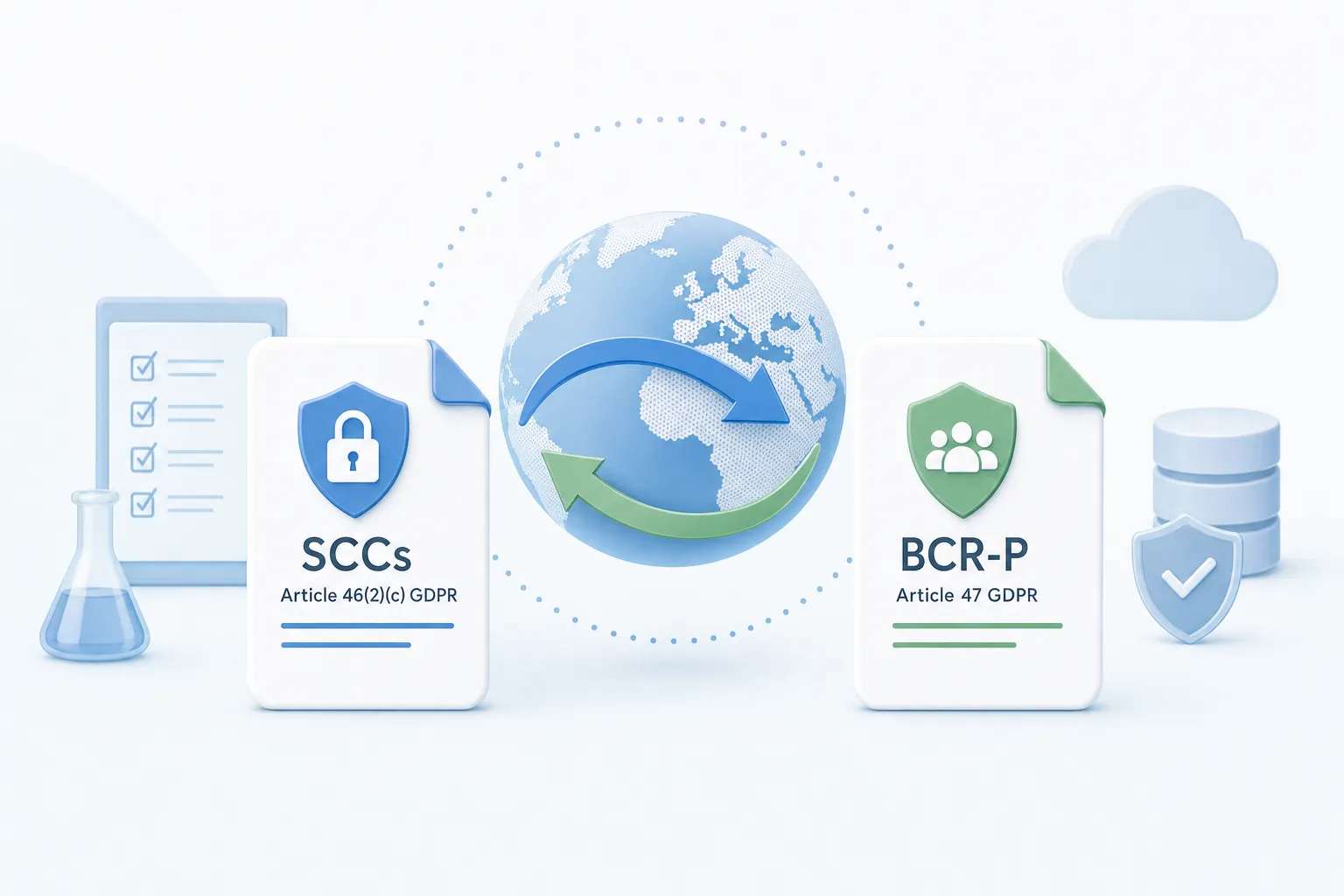
Standard contractual clauses (SCCs) in clinical trials: when do processor BCRs apply instead?
SCCs in clinical trials are the Article 46 GDPR transfer tool. See how they differ from processor BCRs and what EDPB Recommendations 1/2026 change.
