


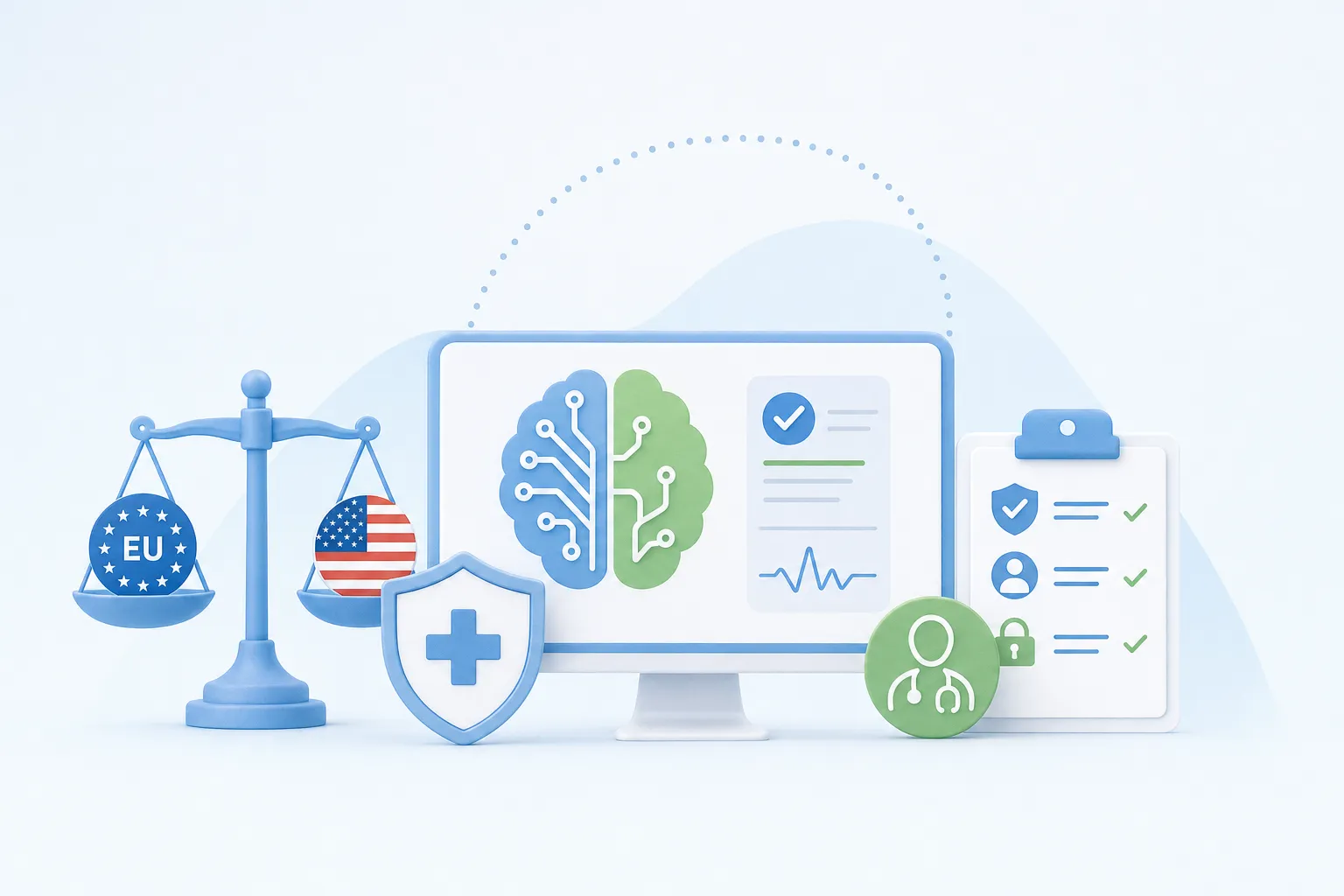
Summary
Clinical decision support software is classified as a medical device in both the EU and US when it informs diagnostic or therapeutic decisions. The EU imposes additional obligations through the MDR, AI Act, and GDPR, while the US primarily relies on FDA guidelines. Proper classification is crucial for compliance and governance in both regions.
Clinical decision support software becomes a regulated medical device in both the EU and the US once it informs a diagnostic or therapeutic decision beyond a narrow carve-out. In the EU, MDR Rule 11 sets the device class, the EU AI Act adds high-risk obligations on top, and the GDPR governs any decision affecting a patient. In the US, the FDA final CDS guidance and the 21st Century Cures Act exclude only software that satisfies four cumulative criteria. The EU stacks three regimes where US law leans mainly on one, so classification is the first governance decision any team must make before procurement, validation or market launch.
Key takeaways
- Clinical decision support software is treated as a medical device under EU MDR Rule 11 whenever it provides information used for diagnostic or therapeutic decisions, which places most clinical AI in Class IIa or higher.
- The EU AI Act treats medical-device AI that needs notified-body conformity assessment as high-risk under Article 6(1), adding obligations that have no direct US equivalent.
- The FDA treats clinical decision support as a non-device only when it meets all four criteria in its final CDS guidance issued on 28 September 2022 under the 21st Century Cures Act.
- GDPR Article 22 restricts decisions based solely on automated processing, so a tool that outputs a binding recommendation needs human oversight and a lawful basis.
- Classification comes first: the same tool can be a regulated device in the EU and a non-device in the US, which changes the whole governance burden.
What counts as clinical decision support software, and when does it become a medical device?
Clinical decision support software is a tool that analyses patient or medical information to help a healthcare professional make a prevention, diagnosis or treatment decision. It becomes a regulated medical device the moment its intended purpose crosses the threshold set by the applicable regime, and that threshold differs sharply between the EU and the US.
For life sciences teams, the decisive question is not what the product does in marketing terms but what it is intended to do in regulatory terms. When clinical decision support software falls inside the device definition, it is usually classified as software as a medical device (SaMD), with all the conformity, quality and post-market duties that follow.
Use this four-gate test as a first-pass classification screen:
- Intended purpose. Does the software claim a medical purpose such as diagnosis, prediction, prognosis or treatment recommendation? A pure administrative or billing tool is out of scope.
- Inputs. Does it acquire, process or analyse a medical image, an in-vitro diagnostic signal or a physiological measurement? Processing such signals pushes the tool firmly into the device category in both the EU and the US.
- Autonomy. Does the output replace or direct the professional's judgment, or does it support a decision the clinician can still independently review? Autonomy raises the regulatory stakes.
- Jurisdiction. Is the tool placed on the EU market, the US market or both? The answer determines which classification rules apply and whether an AI-specific layer attaches.
How does the EU regulate clinical decision support AI?
The EU regulates clinical decision support AI through three stacked regimes: the Medical Device Regulation for device status, the EU AI Act for high-risk AI obligations, and the GDPR for personal data and automated decisions. A single product can be subject to all three at once, which is the structural feature that distinguishes the EU from the US.
Focus: MDR Rule 11 and device classification
Under Regulation (EU) 2017/745 (the Medical Device Regulation), Annex VIII Rule 11 governs standalone software that provides information used to take decisions for diagnostic or therapeutic purposes. Our reading of Rule 11 is that such software is generally Class IIa, moving up to Class IIb where a decision could cause serious deterioration of health or a surgical intervention, and to Class III where it could cause death or an irreversible deterioration. Most clinical decision support software that influences treatment therefore sits at Class IIa or above, which requires involvement of a notified body and CE marking. Teams building or procuring these tools should align their classification rationale early, a task our medical devices data protection service is built to support.
The AI Act high-risk layer
Regulation (EU) 2024/1689 (the EU AI Act) adds a high-risk classification on top of the MDR. Under Article 6(1), an AI system is high-risk when it is a product, or the safety component of a product, covered by the Union harmonisation legislation listed in Annex I (which includes the MDR and the IVDR) and that product must undergo a third-party conformity assessment. In practice this captures most AI-driven clinical decision support that already needs a notified body. High-risk status brings duties on risk management, data governance, technical documentation, logging, transparency and human oversight. The applicability dates for the medical-device tranche are moving and are affected by the Digital Omnibus discussions, so sponsors should confirm the current timeline rather than assume it, as we set out in our guide on what the EU AI Act means for healthcare.
GDPR Article 22 and automated decisions
GDPR Article 22 gives a data subject the right not to be subject to a decision based solely on automated processing that produces legal or similarly significant effects. A clinical decision support tool that merely informs a clinician who then exercises independent judgment is usually not a solely automated decision. A tool that outputs a recommendation acted on without meaningful human review moves closer to Article 22, which requires, where such processing is allowed, at least a right to human intervention and to contest the outcome. Health data is a special category under Article 9, so a lawful basis and appropriate safeguards must be documented regardless.
How does the US regulate clinical decision support software?
The US regulates clinical decision support software mainly through FDA device law, with a statutory carve-out that removes some CDS from the device definition entirely. There is no dedicated federal AI-device statute equivalent to the EU AI Act, so the device-or-not question carries most of the weight.
Focus: the FDA final guidance and the Cures Act four criteria
The 21st Century Cures Act amended the Federal Food, Drug and Cosmetic Act by adding section 520(o), which excludes certain CDS software from the definition of a medical device. The FDA issued its final Clinical Decision Support Software guidance on 28 September 2022 to clarify its oversight of CDS intended for healthcare professionals. Under section 520(o)(1)(E), software is a non-device only when it meets all four of the following conditions, which reviewers should confirm against the guidance text:
- It is not intended to acquire, process or analyse a medical image or an in-vitro diagnostic signal.
- It is intended to display or analyse medical information about a patient.
- It supports or provides recommendations to a healthcare professional and does not replace or direct the professional's judgment.
- It enables the professional to independently review the basis for its recommendations rather than rely primarily on them.
Fail any one criterion, and the software is a regulated device requiring a 510(k), De Novo or premarket approval pathway as applicable. Our guide to US regulatory requirements for AI-powered medical devices maps the FDA, HIPAA and IRB touchpoints in more detail.
EU versus US at a glance
The table compares the two frameworks on the dimensions that most often change a product team's obligations. It is a general orientation, not a classification opinion for any specific product.
<table><tr><th>Dimension</th><th>EU</th><th>US</th></tr><tr><td>Device classification</td><td>MDR Rule 11, Regulation (EU) 2017/745, Annex VIII</td><td>FD&C Act s.520(o), FDA CDS guidance</td></tr><tr><td>AI-specific layer</td><td>EU AI Act high-risk, Regulation (EU) 2024/1689, Article 6(1)</td><td>No dedicated federal AI-device statute</td></tr><tr><td>Non-device carve-out</td><td>No general CDS carve-out</td><td>Four-criteria non-device CDS test</td></tr><tr><td>Data protection</td><td>GDPR, including Article 22</td><td>HIPAA and sectoral rules</td></tr><tr><td>Conformity route</td><td>Notified body and CE marking</td><td>510(k), De Novo or PMA as applicable</td></tr><tr><td>Human oversight</td><td>Mandatory under AI Act and GDPR</td><td>Independent-review criterion</td></tr></table>Where does the AI Act go beyond the FDA, and how do the UK and Switzerland fit?
The AI Act goes beyond the FDA by imposing AI-specific governance duties even where the device is already approved. Where US law largely stops at the device clearance, the EU adds obligations on training data quality, bias monitoring, logging and documented human oversight for the lifetime of the system. There is no US statute that maps onto this layer, so teams cannot assume FDA clearance satisfies EU expectations.
Focus: the example of the United Kingdom (MHRA)
In the UK, the MHRA regulates clinical decision support as a medical device under the UK regime and runs a dedicated change programme for software and AI as a medical device. The UK approach is close to the EU on device status but diverges on the AI-specific layer, as we explain in our note on MHRA compliance for AI-enabled medical devices.
Focus: the example of Switzerland (FADP)
Switzerland regulates the personal data side under the revised Federal Act on Data Protection, in force since 1 September 2023, while device status follows Swissmedic rules. Products reaching Swiss patients therefore need a separate data-protection assessment even when EU documentation exists.
How do you build compliance and governance for SaMD AI used in clinical decision support?
You build compliance and governance for SaMD AI by turning each regulatory obligation into a traceable requirement that can be tested, documented and audited. Requirements management is the thread that links classification to conformity, so the governance file holds together under inspection.
- Classify first. Record a documented classification rationale for every market, because device status drives everything downstream.
- Map obligations to requirements. Translate MDR, AI Act, GDPR and FDA duties into discrete, testable requirements with owners and acceptance criteria.
- Run a DPIA where processing is high-risk. A data protection impact assessment is required for processing likely to result in a high risk to individuals, which clinical AI usually is.
- Document human oversight. Specify how a clinician reviews and can override each output, and evidence it in the technical file.
- Plan for change. Version control, logging and a change-control plan keep an evolving model compliant as it is retrained.
- Keep an audit trail. Maintain traceability from requirement to test to release so a notified body, the FDA or a supervisory authority can follow the chain.
This operational layer is where our AI compliance services focus, so the governance file is built to survive scrutiny rather than written after the fact.
How iliomad supports clinical decision support and SaMD AI governance
iliomad Health Data works with sponsors, CROs, MedTech and HealthTech teams to classify clinical decision support tools, build the AI Act and GDPR documentation, and operate the governance that device and data-protection regimes demand. As practitioners who implement compliance hands-on, we act as outsourced DPO, as EU, UK and Swiss data protection representative, and as AI governance advisers across the product lifecycle. If you are evaluating or building clinical decision support AI, our healthcare compliance team can map your obligations across the EU and US. Get in touch to discuss your classification and governance plan.
FAQs
Our frequently questions
Building robust compliance and governance for clinical decision support AI involves six key steps. First, classify the product in every target market, as device status drives all downstream obligations. Second, map regulatory duties — from the MDR, EU AI Act, GDPR, and FDA guidance — into discrete, testable requirements with clear owners and acceptance criteria. Third, conduct a Data Protection Impact Assessment (DPIA), which is required whenever processing is likely to result in a high risk to individuals — a threshold clinical AI routinely meets. Fourth, document how clinicians review and can override each AI output, evidencing this in the technical file to satisfy both AI Act human-oversight duties and GDPR Article 22 requirements. Fifth, implement version control, logging, and a change-control plan to keep evolving or retrained models compliant over time. Sixth, maintain a full audit trail with traceability from requirement to test to release, ensuring the governance file can withstand scrutiny from a notified body, the FDA, or a data protection supervisory authority.
The fundamental structural difference is that the EU stacks three distinct regulatory regimes — the Medical Device Regulation (MDR), the EU AI Act, and the GDPR — that can all apply to a single clinical decision support product at the same time. The US, by contrast, relies primarily on one regime: FDA device law, with a statutory carve-out for qualifying CDS software and no dedicated federal AI-device statute comparable to the EU AI Act. This means a tool that is classified as a regulated medical device in the EU could simultaneously qualify as a non-device in the US, resulting in dramatically different governance burdens depending on the target market. Classification must therefore be performed separately for each jurisdiction before procurement, validation, or market launch.
GDPR Article 22 gives data subjects the right not to be subject to a decision based solely on automated processing that produces legal or similarly significant effects. A clinical decision support tool that informs a clinician who then exercises genuine independent judgment is generally not considered a solely automated decision and may fall outside the Article 22 restriction. However, a tool whose output is acted upon without meaningful human review moves closer to triggering Article 22, which — where such processing is permitted — requires at minimum a right to human intervention and the ability to contest the outcome. Because patient health data is special-category data under Article 9, a lawful basis and appropriate safeguards must be documented regardless of whether Article 22 applies. This makes human oversight both a clinical and a data-protection requirement under EU law.
Under section 520(o)(1)(E) of the FD&C Act, as interpreted in the FDA's final Clinical Decision Support Software guidance (28 September 2022), CDS software qualifies as a non-device only when it meets all four of the following conditions simultaneously: (1) it is not intended to acquire, process, or analyse a medical image or an in-vitro diagnostic signal; (2) it is intended to display or analyse medical information about a patient; (3) it supports or provides recommendations to a healthcare professional without replacing or directing that professional's independent judgment; and (4) it enables the healthcare professional to independently review the basis for its recommendations rather than relying primarily on them. Failing even one of these criteria means the software is a regulated medical device and must follow the appropriate FDA clearance or approval pathway.
Under Article 6(1) of Regulation (EU) 2024/1689 (the EU AI Act), an AI system is classified as high-risk when it is a product — or a safety component of a product — covered by EU harmonisation legislation listed in Annex I, such as the MDR or IVDR, and that product must undergo a third-party conformity assessment. In practice, this captures most AI-driven clinical decision support tools that already require a notified body under the MDR. High-risk classification brings additional obligations covering risk management, data governance, technical documentation, logging, transparency, and documented human oversight. Crucially, these duties apply on top of MDR conformity and persist for the entire lifetime of the system — there is no equivalent AI-specific federal statute in the US. Teams should confirm current applicability timelines, as the medical-device tranche dates are subject to ongoing Digital Omnibus discussions.
Clinical decision support (CDS) software is a tool that analyses patient or medical information to help a healthcare professional make a prevention, diagnosis, or treatment decision. It becomes a regulated medical device once its intended purpose crosses the threshold set by the applicable regulatory regime. In the EU, MDR Rule 11 (Annex VIII, Regulation (EU) 2017/745) classifies standalone software that provides information used for diagnostic or therapeutic decisions — most commonly as Class IIa or higher. In the US, software only escapes the device definition if it satisfies all four cumulative criteria under section 520(o)(1)(E) of the FD&C Act, as clarified by the FDA's final CDS guidance of 28 September 2022. If any single criterion is not met, the software is a regulated device requiring a 510(k), De Novo, or PMA pathway.
Find out how iliomad can help your company.
Only visible in production

Weekly Privacy and Health-Tech Digest: AI Funding, HIPAA Reform, Data Breaches and Cyber Resilience (17 November 2026)
This week: Isomorphic Labs $5B round, HIPAA Privacy Rule final rule, AI in healthcare governance, EU Cyber Resilience Act guidance, EDPB on onward transfer clauses and multiple US healthcare data breaches.
Standard contractual clauses (SCCs) in clinical trials: when do processor BCRs apply instead?
SCCs in clinical trials are the Article 46 GDPR transfer tool. See how they differ from processor BCRs and what EDPB Recommendations 1/2026 change.
Cross-border data transfers in clinical trials: the DPO's role in choosing mechanisms and monitoring compliance
How the DPO advises on and monitors cross-border data transfers in clinical trials, from SCCs to transfer impact assessments across EEA, UK and Swiss law.
