


Summary
In life sciences, both Data Protection Officers (DPOs) and AI Officers are essential for compliance with GDPR and the EU AI Act. The DPO oversees data protection obligations, while the AI Officer manages AI governance, ensuring human oversight and AI literacy. Decisions on staffing or outsourcing depend on conflict of interest and regulatory complexities.
A data protection officer and an AI officer answer to different rulebooks, and life sciences organisations deploying clinical or diagnostic AI increasingly need both capabilities. The data protection officer is a role codified by the GDPR. The AI officer is an emerging function that no EU text names as a mandatory title, even though the EU AI Act creates obligations that a named person has to own. This article compares the two roles for biotech, pharma, medtech and healthtech, resolves the conflict-of-interest question, and gives a decision framework for choosing to hire, build or outsource.
Key takeaways
- The DPO is mandatory under GDPR Article 37 for organisations whose core activities involve large-scale processing of health data, a threshold most life sciences organisations meet.
- The EU AI Act imposes an AI literacy duty on providers and deployers under Article 4, but it does not create a mandatory AI officer title.
- Deployers of high-risk healthcare AI must assign human oversight to competent, trained and authorised natural persons under AI Act Article 26.
- AI systems that are safety components of medical devices, and healthcare triage systems, are high-risk under the AI Act, so clinical and diagnostic AI sits squarely in scope.
- A DPO may take on AI governance only where no conflict of interest arises, which is why many life sciences teams separate or outsource the functions.
The life sciences coverage test
Before choosing a structure, run four questions that decide which roles your organisation actually needs:
- Do your core activities involve large-scale processing of health or genetic data? If yes, a DPO is a legal requirement, not an option.
- Do you deploy or provide AI that touches patients, diagnosis, triage or clinical decisions? If yes, you carry AI Act deployer or provider obligations that need a named owner.
- Would the person owning AI governance also decide the purposes and means of processing personal data? If yes, a single dual-hat appointment risks a conflict of interest.
- Do you operate across the EU, the UK and Switzerland? If yes, your coverage question is multi-jurisdictional and rarely solved by one internal hire.
The answers point to one of four setups: a DPO only, a DPO who absorbs AI governance, a distinct AI officer alongside the DPO, or an outsourced combination. The rest of this article works through each.
What does a DPO do, and when does GDPR require one in life sciences?
A data protection officer is the independent function that monitors GDPR compliance, advises on data protection impact assessments and acts as the contact point for supervisory authorities and data subjects. Under GDPR Article 37(1)(c), a controller or processor must designate a DPO where its core activities consist of processing special categories of data on a large scale. Health data, genetic data and biometric data are special categories under Article 9, so sponsors, CROs and healthtech companies almost always cross the threshold.
The DPO is deliberately insulated from the business. Article 38 requires that the DPO reports to the highest management level, receives the resources to do the job, and is not instructed on how to perform the role. Critically, Article 38(6) permits the DPO to hold other tasks only where those tasks do not create a conflict of interests, which is the hinge for the dual-hat question later in this article.
GDPR Article 37(6) also confirms that the DPO may perform the tasks on the basis of a service contract. In other words, outsourcing the DPO function to an external provider is expressly contemplated by the regulation, not a workaround.
Focus: the example of France and the CNIL
France illustrates how operational the DPO role becomes in clinical research. A sponsor running a trial in France under the reference methodologies supervised by the CNIL must map health data flows, document a lawful basis and maintain records of processing. The DPO is the function that keeps that documentation audit-ready and interfaces with the CNIL. This is implementation work, not a legal opinion, and it recurs every time a protocol, vendor or transfer changes.
What does an AI officer do, and what does the EU AI Act actually require?
An AI officer is the function that owns an organisation's AI governance: inventorying AI systems, classifying their risk, overseeing human oversight arrangements and coordinating conformity work. It is an emerging role that the EU AI Act does not name as a mandatory title. What the AI Act does is distribute obligations that a person or team must own.
Two obligations matter most for life sciences. First, Article 4 of the EU AI Act requires providers and deployers to take measures to ensure a sufficient level of AI literacy among staff and other persons operating AI systems on their behalf. Second, for high-risk systems, Articles 26 and 27 of the EU AI Act require deployers to assign human oversight to natural persons who have the necessary competence, training and authority, and to carry out a fundamental rights impact assessment where applicable, which may cross-reference an existing GDPR DPIA.
So the AI officer label is optional, but the underlying accountability is not. Someone has to maintain the AI inventory, run the AI literacy programme and sign off human oversight. In practice, a life sciences organisation that deploys clinical AI without an owner for these tasks is carrying unassigned regulatory risk.
Focus: the example of high-risk healthcare AI under Annex III
Annex III of the AI Act lists AI systems used to evaluate eligibility for essential services including healthcare, and emergency healthcare patient triage systems, as high-risk AI systems. A healthtech company deploying a triage or eligibility model is therefore a deployer of a high-risk system and inherits the human oversight and fundamental rights impact assessment duties. According to the consolidated AI Act text, Annex III obligations under Chapter III apply from 2 December 2027, which gives deployers a concrete planning horizon rather than an open-ended deadline.
Focus: the example of medical device AI under MDR and IVDR
Annex I of the AI Act lists the Medical Device Regulation 2017/745 and the In Vitro Diagnostic Regulation 2017/746 among the Union harmonisation legislation. AI that is a safety component of a device regulated under MDR or IVDR, including software as a medical device, is high-risk under Article 6(1). For a medtech or diagnostics company, AI governance is therefore not separate from device compliance, it is woven into the same conformity file. The consolidated text applies Chapter III to these Annex I systems from 2 August 2028, later than the Annex III date, which matters for sequencing compliance work.
AI officer vs DPO: how do the two roles compare?
The short answer is that the DPO owns personal data compliance under one regulation, while the AI officer owns AI system governance under another, and the two intersect whenever an AI system processes personal data. The table below sets out the practical differences for a life sciences team.
<table><tr><th>Dimension</th><th>Data protection officer</th><th>AI officer</th></tr><tr><td>Legal basis</td><td>GDPR Article 37, mandatory on trigger</td><td>No mandatory title in the AI Act; obligations in Articles 4, 26 and 27</td></tr><tr><td>Primary scope</td><td>Processing of personal data, especially health and genetic data</td><td>AI systems, risk classification, human oversight, AI literacy</td></tr><tr><td>Key assessment</td><td>Data protection impact assessment, GDPR Article 35</td><td>Fundamental rights impact assessment, AI Act Article 27</td></tr><tr><td>Independence</td><td>Statutory, must avoid conflict of interests (Art 38(6))</td><td>Governance role; independence is good practice, not codified</td></tr><tr><td>Core skills</td><td>Data protection law, health data, transfers, audits</td><td>AI Act, model risk, MDR and IVDR interplay, technical oversight</td></tr><tr><td>Outsourcing</td><td>Expressly allowed by service contract (Art 37(6))</td><td>Commonly fractional or outsourced given scarce talent</td></tr></table>
Can your DPO also be your AI officer?
Sometimes, but only where no conflict of interest arises. GDPR Article 38(6) allows the DPO to hold other tasks provided they do not place the DPO in a position to determine the purposes and means of processing. A DPO who also governs AI systems can remain compliant, because advising on and monitoring AI governance is close to the DPO's existing advisory remit. The conflict appears when the same person both designs or deploys the AI systems and is meant to oversee them independently.
There is also a skills question. A fundamental rights impact assessment and human oversight of a clinical model require AI-specific competence that not every DPO holds. Our reading, in practice, is that many life sciences organisations keep the DPO role distinct from AI governance operations, while allowing the DPO to advise on the data protection dimension of AI. The AI Act and the market are still evolving, so treat any structure as case-by-case rather than settled.
Decision framework: do you need a DPO, an AI officer, or both?
Most life sciences organisations that process health data and deploy AI need both competencies covered, even if not by two separate hires. Use the coverage test above to place yourself:
- DPO only. You process health data at scale but do not yet deploy or provide AI in regulated use cases. Assign the DPO and keep an AI literacy baseline under Article 4.
- DPO absorbing AI governance. Your AI use is limited and advisory, and your DPO has the competence, with no conflict of interest. Document the arrangement and the human oversight model.
- DPO plus distinct AI officer. You deploy high-risk healthcare AI, build or materially configure models, or face MDR or IVDR interplay. Separate the functions to preserve independence and skills depth.
- Outsourced combination. You lack internal bandwidth or multi-jurisdictional reach. An external mandate covers one or both roles with documented independence.
Hire, build or outsource: what makes commercial sense for life sciences?
The commercial answer depends on data risk, AI exposure and geographic footprint, not on headcount alone. Outsourcing is not automatically cheaper, but it changes the cost shape from a fixed salary to a scoped mandate, and it solves the scarcity of combined privacy and AI competence. For an early-stage biotech or a healthtech scale-up, a fractional external DPO or AI compliance mandate often delivers audit-ready coverage faster than recruiting a senior hire who must cover both domains.
Focus: the example of EU, UK and Swiss coverage
A sponsor running trials across the EU, the UK and Switzerland faces three regimes at once: the GDPR, the UK GDPR and the Swiss FADP, plus the EU AI Act for AI deployed in the EU. A single internal hire rarely covers all three with equal depth. This is where an outsourced mandate with multi-jurisdictional reach, combined where needed with EU, UK and Swiss data protection representation, keeps coverage consistent as the footprint grows. For the sequencing of AI Act duties against existing GDPR work, our analysis of what life sciences companies need to know about the EU AI Act for healthcare sets out the planning view.
How iliomad helps
iliomad acts as an outsourced DPO and as an outsourced AI officer for biotech, pharma, medtech and healthtech organisations. We implement the governance rather than opine on it: building the AI inventory, running the AI literacy programme, structuring human oversight and fundamental rights impact assessments, and keeping your GDPR documentation audit-ready, with independence designed in to avoid conflicts of interest. Where your footprint spans the EU, the UK and Switzerland, we align representation and governance across all three. To scope a DPO mandate, an AI officer mandate or both, get in touch with iliomad.
FAQs
Our frequently questions
Outsourcing makes sense when internal bandwidth is limited, combined privacy and AI competence is scarce, or when the organisation operates across multiple jurisdictions. GDPR Article 37(6) expressly permits the DPO to be appointed via a service contract. For organisations operating across the EU, the UK and Switzerland — each with its own regime (GDPR, UK GDPR and Swiss FADP) plus the EU AI Act — a single internal hire rarely provides equal depth across all frameworks. A fractional or outsourced mandate can deliver audit-ready coverage faster than recruiting, while also changing the cost shape from a fixed salary to a scoped engagement.
A Data Protection Impact Assessment (DPIA) is required under GDPR Article 35 and is owned by the DPO function — it focuses on risks to individuals arising from the processing of personal data. A Fundamental Rights Impact Assessment (FRIA) is required under EU AI Act Article 27 for deployers of high-risk AI systems and is owned by the AI officer function — it assesses broader impacts on fundamental rights beyond data protection. The two assessments can cross-reference each other where an AI system also processes personal data, which is common in clinical and diagnostic AI.
Two main categories apply to life sciences. First, Annex III of the AI Act lists emergency healthcare patient triage systems and AI used to evaluate eligibility for essential healthcare services as high-risk — obligations for these apply from 2 December 2027. Second, Annex I covers AI that is a safety component of a medical device regulated under MDR (2017/745) or IVDR (2017/746), including software as a medical device — obligations for these apply from 2 August 2028. Clinical and diagnostic AI therefore sits squarely in scope.
Sometimes, but only where no conflict of interest arises. GDPR Article 38(6) permits a DPO to hold other tasks provided those tasks do not place them in a position to determine the purposes and means of processing. A conflict emerges when the same person both designs or deploys AI systems and is meant to oversee them independently. There is also a skills consideration — fundamental rights impact assessments and clinical model oversight require AI-specific competence that not every DPO holds. In practice, many life sciences organisations keep the two functions separate.
No. The EU AI Act does not create a mandatory AI officer title. However, it does distribute obligations that someone must own — including ensuring sufficient AI literacy among staff (Article 4), assigning human oversight to competent and trained persons for high-risk systems (Article 26), and carrying out fundamental rights impact assessments (Article 27). The label is optional, but the underlying accountability is not.
Yes. Under GDPR Article 37(1)(c), a controller or processor must designate a DPO where its core activities involve large-scale processing of special categories of data. Health data, genetic data and biometric data all qualify as special categories under Article 9, meaning most sponsors, CROs and healthtech companies cross the threshold and are legally required to appoint a DPO.
Find out how iliomad can help your company.
Only visible in production

Weekly Regulatory Digest: Healthcare Data Breaches, AI Governance and Life Sciences Compliance
This week's regulatory digest covers HIPAA breaches, AI liability in clinical settings, EHDS implementing acts, Alberta HIA amendments and more for life sciences teams.
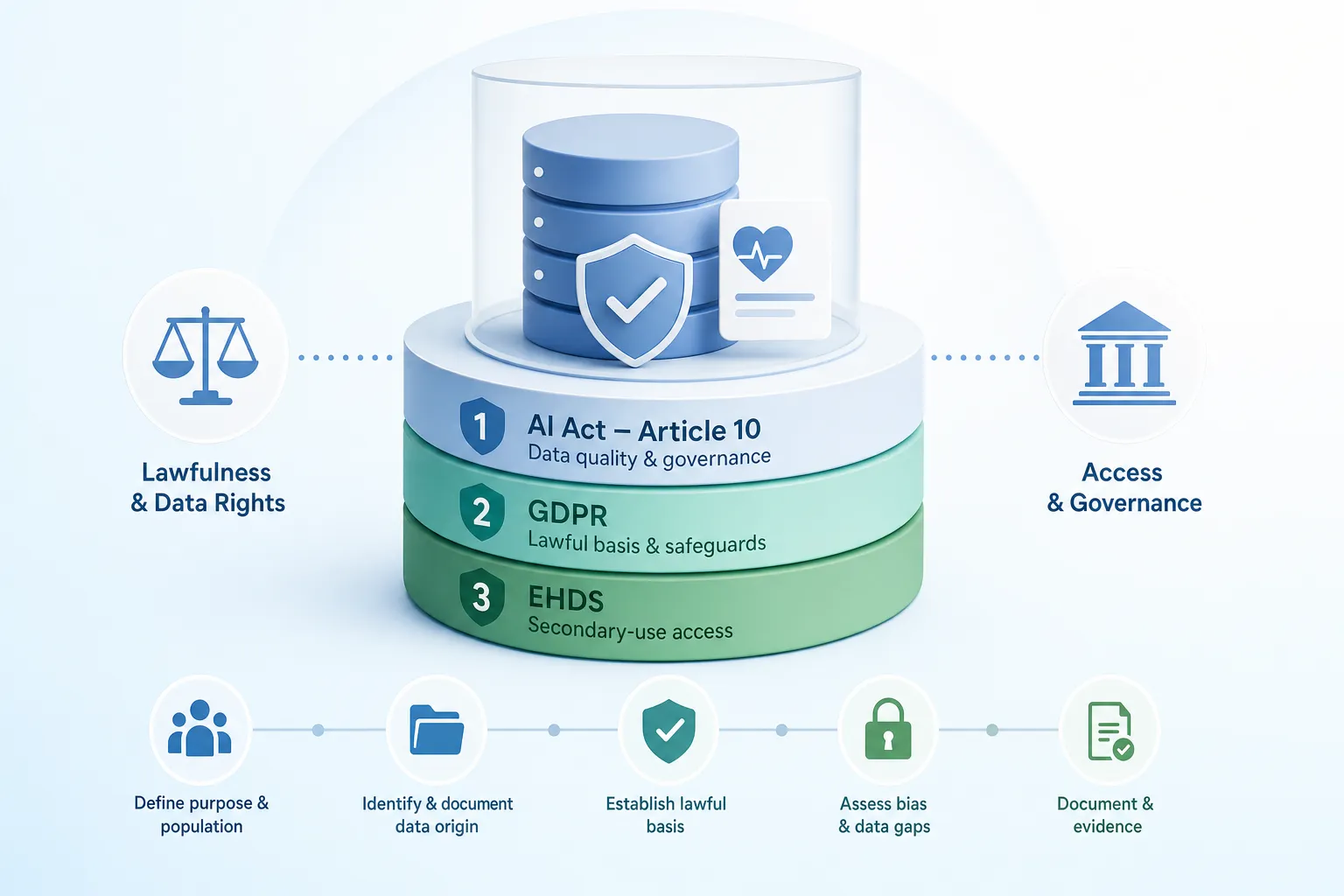
Training data for medical AI in the EU: AI Act Article 10, GDPR and the EHDS
Article 10 of the AI Act, GDPR and the EHDS govern medical AI training data in the EU. Practical guidance for life sciences teams on sourcing it lawfully.
CTA data protection clauses and the new right to health data traceability
How the EHDS Regulation and the AEPD 2026 decision reshape CTA data protection clauses on health data access and traceability before March 2027.
