


Summary
This week's digest highlights significant healthcare data breaches, emphasizing ongoing HIPAA compliance challenges. Key issues include ransomware attacks, AI liability in clinical settings, and regulatory updates across various regions. Organizations must enhance risk management practices to protect sensitive health information effectively.
This digest covers the most significant developments in data protection, AI regulation and life sciences compliance for the week ending 28 November 2026. Items span HIPAA enforcement, healthcare ransomware trends, AI liability in clinical settings, the European Health Data Space, and legislative updates in Norway, Alberta and Japan.
1. Data Protection and Healthcare Privacy
Prism Medical Products Breach Affects 1.3 Million Patients
Prisma Medical Products, LLC, a North Carolina home medical equipment supplier owned by Henry Schein Inc., filed a breach notice dated 30 October 2026 disclosing that an unauthorised party accessed its network and obtained files containing patient information. Suspicious activity was first identified on 19 October 2026. The breach is reportable under the Health Insurance Portability and Accountability Act (HIPAA), the United States federal law governing the privacy and security of protected health information, and illustrates the ongoing pressure on healthcare supply-chain entities to maintain robust network-monitoring programmes. Organisations processing protected health information should review vendor access controls and incident-detection timelines as standard risk-management practice.
Four US Healthcare Providers Report Separate Data Breaches
Access Dental Management, Monadnock Community Hospital, Valley Family Health Care and Ochsner Health each disclosed distinct data security events in November 2026. Access Dental alone notified the Texas Attorney General of a breach affecting at least 341,039 Texas residents, with exposed data including Social Security numbers and health and insurance information. The clustering of disclosures reflects the healthcare sector's elevated threat profile and reinforces the obligation, under HIPAA's Breach Notification Rule, to notify affected individuals and the Department of Health and Human Services within 60 days of discovery. Each incident warrants an independent root-cause analysis before drawing systemic conclusions.
Yuma Regional Medical Center Settles 2022 Ransomware Class Action for Nearly $2 Million
Yuma Regional Medical Center (operating as Onvida Health) agreed to pay $1,985,000 to resolve consolidated class-action litigation arising from a ransomware attack occurring between 21 and 25 April 2022, in which intruders exfiltrated data before encrypting hospital systems. The hospital reported 738,145 affected individuals to the HHS Office for Civil Rights. The settlement in Dillon Clarke et al. v. Yuma Regional Medical Center (D. Ariz.) underlines that the litigation tail on a healthcare data breach can extend several years, compounding reputational and financial exposure well beyond any regulatory penalty.
Healthcare Leads All Sectors in Q3 2026 Ransomware Disclosures
BlackFog's Q3 2026 State of Ransomware Report recorded 353 publicly disclosed ransomware attacks across industries in Q3 2026, a 20 percent increase on Q3 2025, alongside 2,668 further attacks claimed only on dark-web leak sites and never formally disclosed, representing a 77 percent year-on-year rise. Healthcare topped all sectors in public disclosures. The data suggest that roughly one in nine attacks is ever publicly acknowledged, a ratio with serious implications for the accuracy of board-level risk assessments and for regulators assessing sector-wide compliance with breach-notification obligations.
SBC Medical Group Discloses Breach Affecting 1.6 Million Customers in Japan
SBC Medical Group, a Japan-headquartered clinic operator recording approximately 7 million patient visits annually, disclosed via a US Securities and Exchange Commission filing that hackers stole data on approximately 1.6 million customers across two separate incidents, with a breach date of 16 November 2026. The exposed data set includes full names, contact details, dates of birth and patient records. The SEC filing route for a Japan-based operator highlights how cross-listed or US-registered entities face layered disclosure obligations, triggering both domestic Japanese Personal Information Protection Act (APPI) duties and US securities-law requirements simultaneously.
Hong Kong Suspends Gleneagles eHealth Access After Patient Data Breach
On 18 November 2026, Gleneagles Hospital Hong Kong detected unusual activity in third-party-managed security infrastructure supporting its 'My Gleneagles SmartHealth' patient application, confirming that personal data including names, identification numbers and contact details had been accessed without authorisation. Medical records and payment data were stated to be unaffected. The incident highlights the data-protection risks that arise when hospitals delegate infrastructure management to external service providers without maintaining adequate oversight, a concern equally relevant under the General Data Protection Regulation (GDPR) in European jurisdictions.
Panama Approves RIPD Standard Contractual Clauses for International Transfers
Panama's data protection authority ANTAI issued Resolution No. ANTAI-DG-003-2026 of 26 March 2026, published in Official Gazette No. 30541-A, adopting the Ibero-American Data Protection Network (RIPD) Standard Contractual Clauses as an approved mechanism for international transfers of personal data under Law 81/2019 and Executive Decree 285/2021. The clauses cover controller-to-controller and controller-to-processor transfers. Life sciences sponsors and contract research organisations with Latin American trial sites or data-processing arrangements should assess whether existing transfer mechanisms remain adequate or whether the RIPD clauses offer a compliant alternative pathway.
2. AI Regulation and Governance in Life Sciences
Study Finds Doctors Risk Greater Malpractice Liability for Overriding AI Diagnoses
Researchers led by Michael Bernstein at Brown University's Warren Alpert Medical School conducted simulated malpractice trials with mock juries to assess how an AI diagnostic tool's disagreement with a clinician affects perceived liability, publishing their findings in NEJM AI. Jurors sided with the plaintiff in 72.9 percent of cases involving a missed brain haemorrhage and in 78.7 percent of cases involving a missed lung cancer where the AI had flagged the finding. The results suggest that AI-assisted clinical decision support (CDSS), defined as software that analyses patient data and provides recommendations to support clinician judgement, is already reshaping liability expectations in ways that existing professional liability frameworks were not designed to address.
Playbook Raises €8 Million to Keep AI Agents GMP-Compliant in Pharma
Munich-based Playbook, led by CEO Dr Nikolai Wessendorf, closed an €8 million funding round led by Heal Capital with participation from Bayern Kapital and Capnamic, bringing total funding to €10.5 million. The company's 'Operating Memory' technology extracts procedural knowledge from a pharmaceutical manufacturer's documents, quality systems and laboratory environments to keep AI agents operating within Good Manufacturing Practice (GMP) requirements. The investment reflects growing industry recognition that deploying AI in regulated manufacturing contexts requires a governance layer that maps AI actions against validated procedures in real time, a requirement relevant both to EU AI Act obligations for high-risk systems and to existing GMP regulatory frameworks.
GE HealthCare Receives FDA Clearance for On-Device AI Feeding Tube Detection
GE HealthCare announced FDA 510(k) clearance (K253502) for Critical Care Suite 3.0, an upgrade to its mobile X-ray portfolio adding on-device AI detection of enteric tube placement, now extended to paediatric patients alongside adults. The AI runs entirely on the mobile X-ray unit without cloud or internet connectivity, automatically generating alerts for clinical review. The clearance is a practical illustration of Software as a Medical Device (SaMD) AI, defined as software intended to perform medical functions without being part of a hardware medical device, meeting US regulatory requirements while operating in an air-gapped configuration that reduces certain cybersecurity attack surfaces.
DNSFilter Survey: Healthcare Lags on AI and SaaS Oversight
A DNSFilter report titled 'AI Security in Healthcare', based on a June 2026 survey of 400 cross-industry managers including a 30-respondent healthcare subsample, found that 60 percent of healthcare respondents rely on AI and SaaS vendors to self-report security incidents, compared with a 43 percent average in other sectors, while only 23 percent of healthcare organisations actively monitor AI tool usage. The survey also documented existing shadow AI incidents in the sector. For regulated organisations, unsanctioned use of AI tools may constitute a failure of data governance obligations, including those under GDPR Article 32 on appropriate technical and organisational security measures.
3. Other Life Sciences Regulatory Developments
EHDS Draft Implementing Acts Published for Feedback
On 23 November 2026, the European Commission published two draft implementing regulations under Regulation (EU) 2025/327, the European Health Data Space (EHDS) Regulation, which establishes a framework for the sharing and secondary use of health data across the European Union, for public feedback on the Have Your Say portal. The first covers secure processing environments (SPEs) under Article 73(5), setting technical, organisational, information-security, data-protection and interoperability requirements for the environments through which data users access health data for secondary purposes. The second covers the European Electronic Health Record exchange format (EEHRxF) under Article 15, specifying interoperability standards for primary health data exchange. Feedback is open until 21 December 2026, and life sciences organisations with an interest in secondary health data access should review the SPE requirements in particular.
Norway Amends Health Research Act with Effect from 1 November 2026
Amendments to Norway's Health Research Act (Act of 20 June 2025 No. 71), enacted through Prop. 109 L (2024-2025), entered into force on 1 November 2026 with no transitional provisions. Key changes include an exemption from Regional Ethics Committee (REK) approval for register-based studies and revised rules on institutional responsibility. Clinical trials of medicinal products and medical devices remain subject to the EU Clinical Trials Regulation 536/2014 as applied in Norway. Sponsors and investigators running Norwegian health research studies should confirm whether ongoing or planned studies fall within the revised scope and whether institutional review processes need updating accordingly.
Alberta Enacts Health Information Act Amendments Covering AI and PIAs
Amendments to Alberta's Health Information Act (HIA), introduced by the Health Statutes Amendment Act, 2025 (No. 2) (Bill 11), came into force on 22 June 2026, with further provisions effective 2 July 2026 as confirmed by the Office of the Information and Privacy Commissioner of Alberta (OIPC Alberta). The amendments introduce new obligations around privacy impact assessments (PIAs), rules for shared health information arrangements, updated de-identification standards and requirements governing the use of artificial intelligence by health information custodians and information managers. Organisations operating in Alberta's health sector, including those conducting clinical research or deploying health AI tools, should assess compliance with the revised HIA framework.
Japan Revises Ethical Guidelines for Life Science Research from 1 December 2026
Japan's Ministries of Education, Culture, Sports, Science and Technology (MEXT), Health, Labour and Welfare (MHLW) and Economy, Trade and Industry (METI) jointly published a partial amendment to the Ethical Guidelines for Life Science and Medical Research Involving Human Subjects in the Official Gazette on 27 August 2026, applicable from 1 December 2026. Key changes unify consent terminology under a single 'informed consent' concept, replace the previous tiered distinctions between written, oral and 'appropriate' consent, and introduce centralised ethics review procedures. Sponsors and investigators with ongoing or planned Japanese research programmes must update informed consent forms and standard operating procedures before the effective date.
Japan's PPC Proposes Strengthened APPI Security Obligations
On 29 October 2026, Japan's Personal Information Protection Commission (PPC) opened public consultation (e-Gov case no. 240000133, closing 27 November 2026) on draft amendments to the security control measures annex of the Act on the Protection of Personal Information (APPI) General Guidelines and the My Number guidelines. The draft adds 'detection of unauthorised access' as a fifth mandatory technical safeguard alongside existing controls, and introduces requirements for multi-factor authentication and a prohibition on password reuse. Pharmaceutical companies and medical device manufacturers holding Japanese personal data, including patient or clinical trial participant records, should monitor the final text and plan implementation accordingly.
A Note on AI-Driven Vulnerabilities in Medical Imaging Tools
Amazon Threat Intelligence researchers documented a campaign, active between 8 and 10 September 2026 and targeting educational institutions in East Asia (excluding mainland China), in which a China-linked actor directed an exposed, unauthenticated instance of Cairn, an open-source autonomous AI penetration-testing framework, to obtain shell access to target systems. Separately, security researcher Abhinav Agarwal disclosed two vulnerabilities in OFFIS DCMTK, a widely deployed open-source DICOM (Digital Imaging and Communications in Medicine) medical imaging toolkit used across versions 3.5.4 through 3.7.0. CVE-2026-125130 carries a critical CVSS score of 9.1 and allows an unauthenticated network peer to trigger unauthorised deletion of patient imaging data. Organisations deploying open-source medical imaging software should apply available patches and review network-exposure configurations, particularly given the medical device regulatory obligations that may attach to such tools under the EU Medical Device Regulation (MDR, Regulation (EU) 2017/745).
(Read more) and https://www.hipaajournal.com/office-dcmtk-toolkit-vulnerabilities-nov-2026/
If your organisation needs guidance on healthcare data breach response, AI governance frameworks, EHDS secondary-use readiness or cross-border data transfer compliance, the iliomad team is available to assist. Contact us to discuss your specific regulatory context.
FAQs
Our frequently questions
A joint amendment by Japan's MEXT, MHLW and METI to the Ethical Guidelines for Life Science and Medical Research Involving Human Subjects became applicable from 1 December 2026. Key changes include: (1) unification of consent terminology under a single 'informed consent' concept, replacing previous tiered distinctions between written, oral and 'appropriate' consent; and (2) the introduction of centralised ethics review procedures. Sponsors and investigators with ongoing or planned Japanese research programmes must update their informed consent forms (ICFs) and standard operating procedures (SOPs) before the effective date to ensure compliance. Additionally, Japan's Personal Information Protection Commission (PPC) is proposing strengthened APPI security obligations — including multi-factor authentication and intrusion detection requirements — which pharmaceutical companies holding Japanese patient or clinical trial data should also monitor closely.
Security researcher Abhinav Agarwal disclosed two vulnerabilities in OFFIS DCMTK, a widely used open-source DICOM medical imaging toolkit (versions 3.5.4 through 3.7.0). The most critical — CVE-2026-125130 — carries a CVSS score of 9.1 and allows an unauthenticated network peer to trigger unauthorised deletion of patient imaging data. Organisations deploying open-source medical imaging software should immediately apply available patches, review network-exposure configurations to restrict unauthenticated access, and assess whether regulatory obligations under the EU Medical Device Regulation (MDR, Regulation (EU) 2017/745) apply to these tools. These vulnerabilities also highlight the broader risk of AI-driven attack frameworks being directed at healthcare infrastructure.
Amendments to Alberta's Health Information Act (HIA), introduced by Bill 11 (Health Statutes Amendment Act, 2025 No. 2), came into force from 22 June and 2 July 2026. The updated framework introduces new obligations for Privacy Impact Assessments (PIAs), revised de-identification standards, rules for shared health information arrangements, and — critically — specific requirements governing the use of artificial intelligence by health information custodians and information managers. Organisations operating in Alberta's health sector, including those conducting clinical research or deploying health AI tools, should conduct a gap assessment against the revised HIA requirements and update their PIA processes and AI governance policies accordingly.
On 23 November 2026, the European Commission published two draft implementing regulations under the European Health Data Space (EHDS) Regulation (EU) 2025/327 for public feedback, open until 21 December 2026. The first sets technical, organisational, information-security, data-protection and interoperability requirements for Secure Processing Environments (SPEs) through which data users access health data for secondary purposes (e.g. research). The second specifies interoperability standards for the European Electronic Health Record exchange format (EEHRxF). Life sciences organisations — particularly those interested in secondary health data access for clinical research or real-world evidence — should review the SPE requirements closely and consider submitting feedback via the European Commission's Have Your Say portal before the deadline.
Research published in NEJM AI by Michael Bernstein and colleagues at Brown University found that mock jurors sided with plaintiffs in roughly 72–79% of simulated malpractice cases where a clinician overrode an AI diagnostic tool that had correctly flagged a condition (such as a brain haemorrhage or lung cancer). This suggests that AI-assisted clinical decision support systems (CDSS) are already reshaping liability expectations in ways that existing professional liability frameworks were not designed to address. Healthcare organisations deploying AI diagnostic tools should review their clinical governance policies, clinician training protocols, and documentation standards to reflect this evolving liability landscape.
Under HIPAA's Breach Notification Rule, covered entities must notify affected individuals and the Department of Health and Human Services (HHS) within 60 days of discovering a breach involving protected health information (PHI). Recent incidents — including breaches at Access Dental Management, Monadnock Community Hospital, Valley Family Health Care and Ochsner Health — illustrate that exposed data commonly includes Social Security numbers, health records and insurance information. Beyond notification, organisations should conduct an independent root-cause analysis for each incident and review vendor access controls and incident-detection timelines as part of standard risk management.
Find out how iliomad can help your company.
Only visible in production
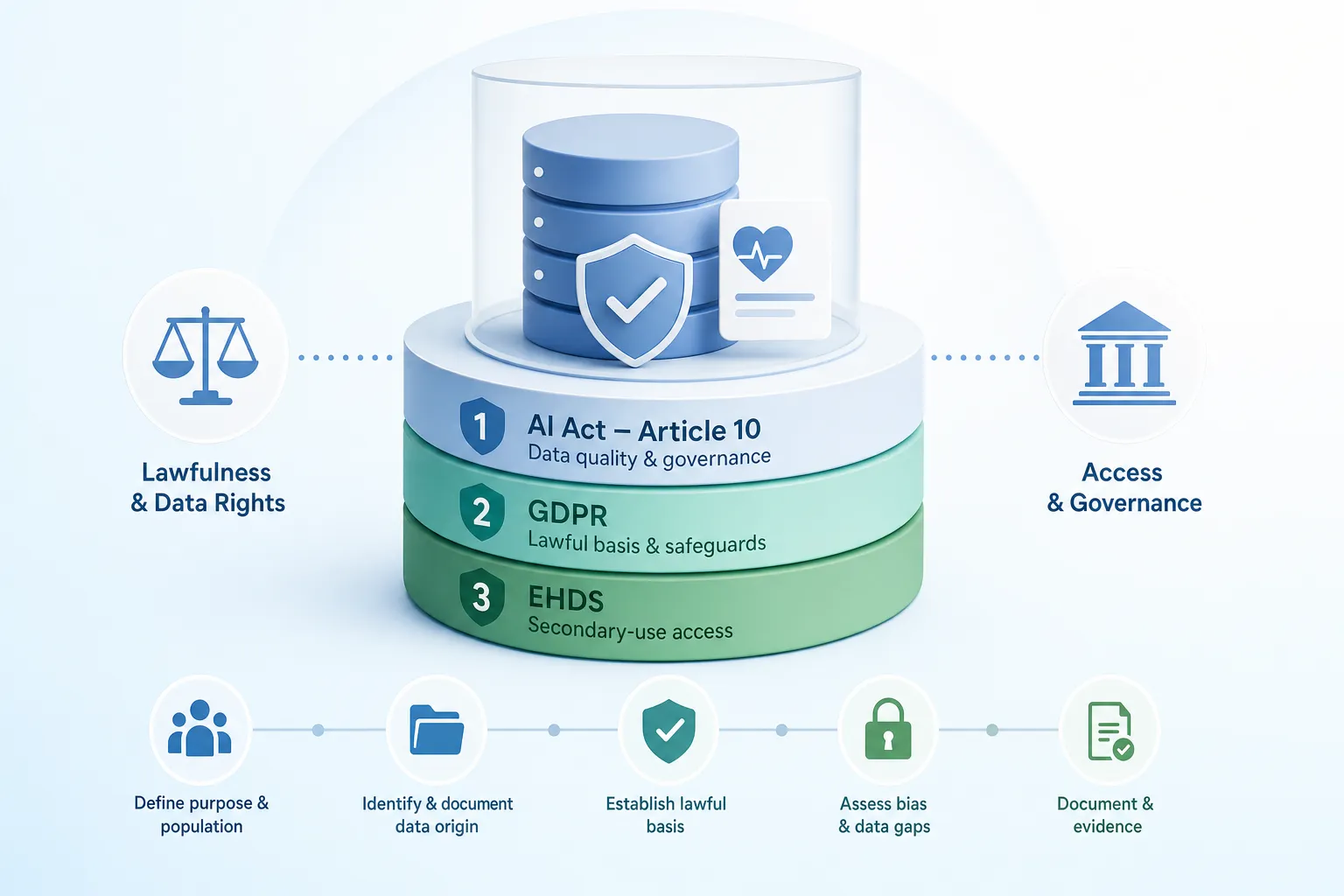
Training data for medical AI in the EU: AI Act Article 10, GDPR and the EHDS
Article 10 of the AI Act, GDPR and the EHDS govern medical AI training data in the EU. Practical guidance for life sciences teams on sourcing it lawfully.
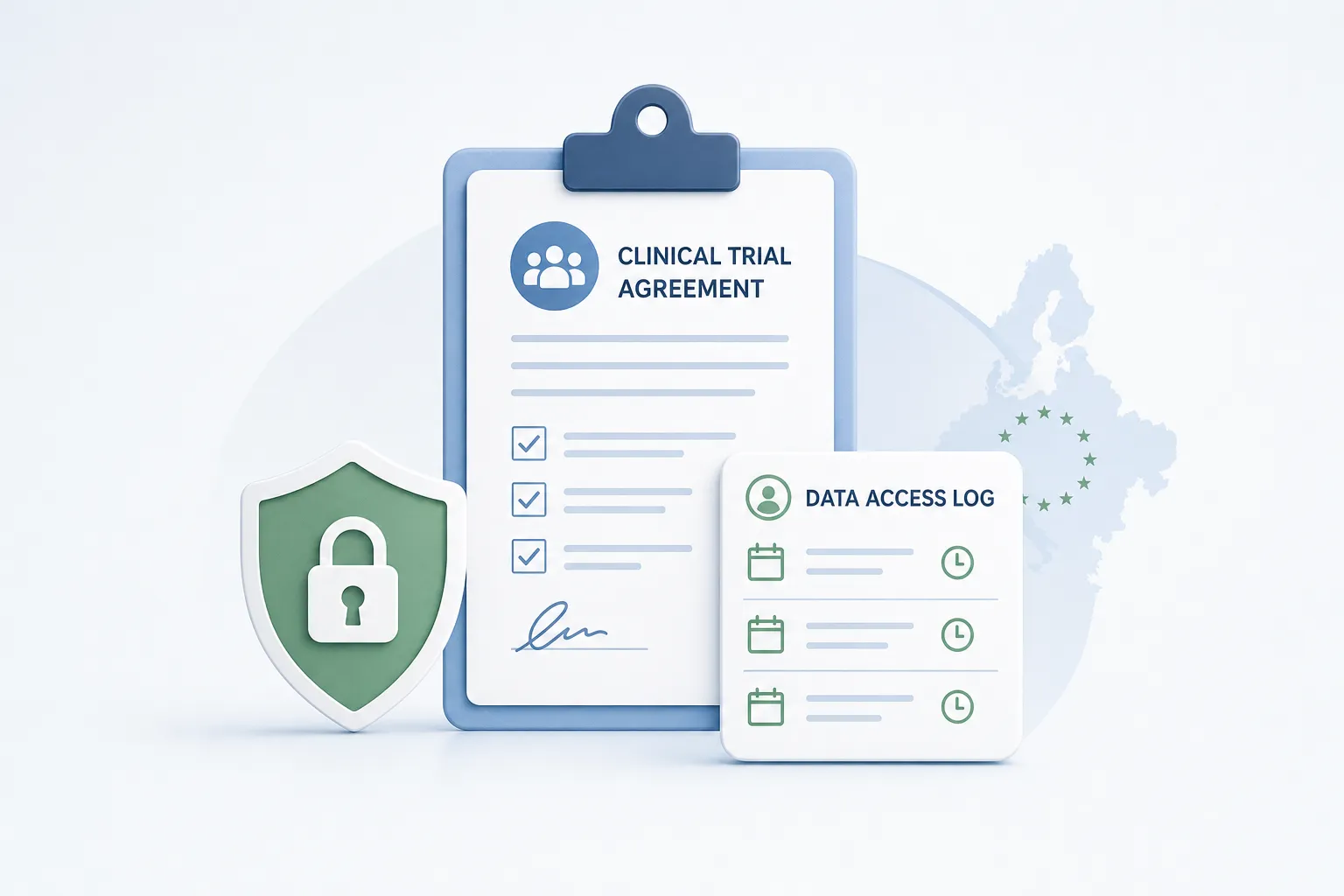
CTA data protection clauses and the new right to health data traceability
How the EHDS Regulation and the AEPD 2026 decision reshape CTA data protection clauses on health data access and traceability before March 2027.

SCCs Clinical Trial Sites: Why Spanish Sites Require Full SCC Embedding in CTAs
Spanish clinical trial sites rarely accept SCCs by reference. Learn why full SCC embedding in CTAs is required and how to avoid operational delays.
