


Summary
The upcoming changes to the HIPAA Privacy Rule in 2026 will tighten access timelines to 15 days, prompting EU organizations to proactively audit their procedures under the EHDS and GDPR frameworks. Key access rights will be strengthened, paralleling shifts towards more stringent timelines for health data requests across transatlantic environments.
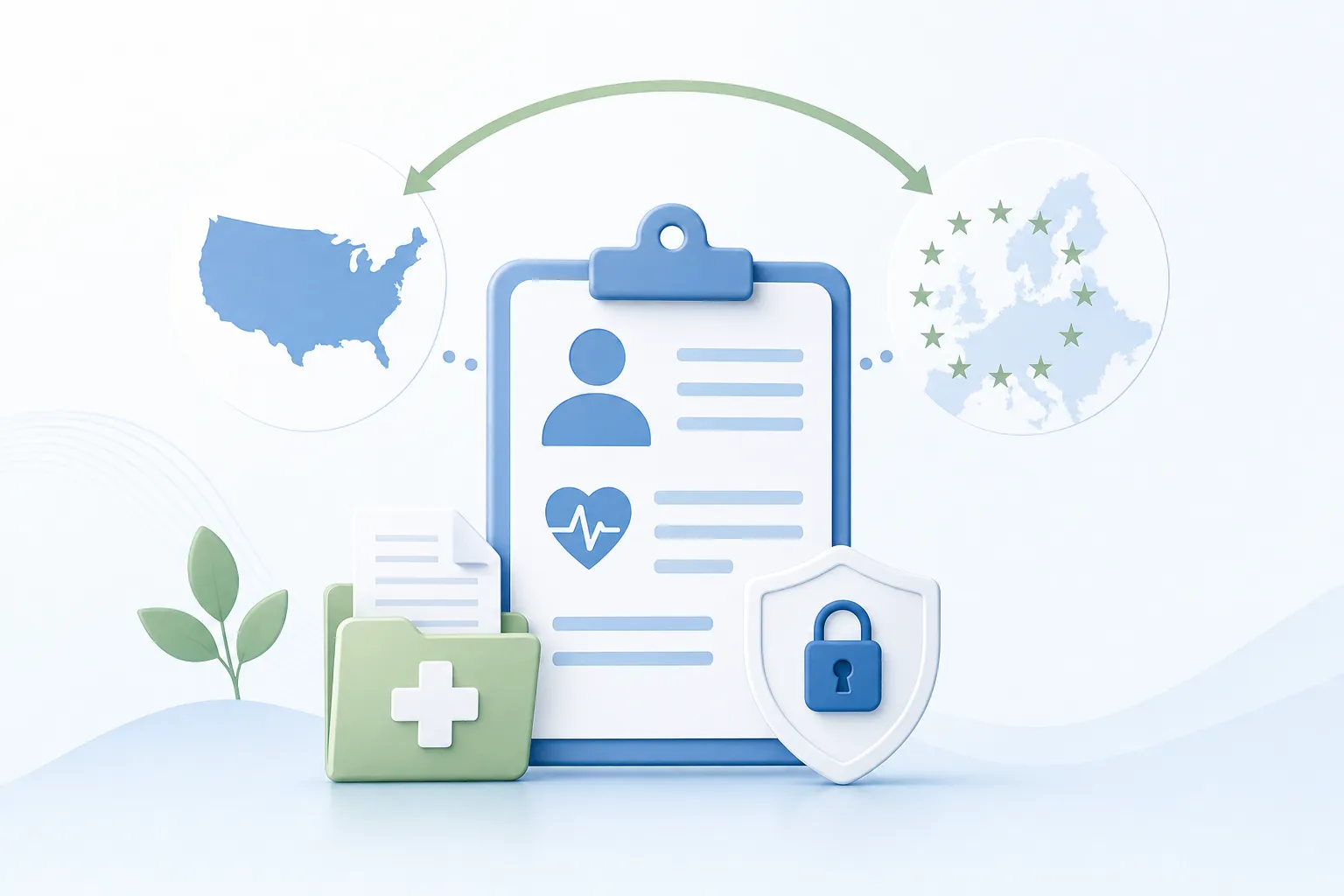
The United States Department of Health and Human Services Office for Civil Rights (HHS OCR) published a final rule amending the Health Insurance Portability and Accountability Act (HIPAA) Privacy Rule on 19 November 2026 (FR Doc. 2026-23429), with a compliance deadline of 19 July 2027. The rule cuts the standard response window for individual access requests from 30 calendar days to 15, reinforces the right to receive electronic copies of health records, and tightens fee transparency obligations. For EU-facing organisations operating across transatlantic health data environments, the reform is a timely prompt to audit procedures under the European Health Data Space (EHDS) Regulation and the General Data Protection Regulation (GDPR).
What Is the European Health Data Space and Why Does It Matter for Individual Access Rights?
The European Health Data Space (EHDS) is an EU regulatory framework, established under Regulation (EU) 2025/327, that creates harmonised rules for the primary use of personal health data by individuals and healthcare providers, as well as a secondary use pathway for research, innovation and policy purposes. It matters for individual access rights because it introduces a MyHealth@EU infrastructure through which citizens across all Member States can access, share and control their electronic health data, supplementing the existing access rights already guaranteed under Articles 15 and 20 of the GDPR.
The EHDS does not replace GDPR data subject rights; it operationalises them in a health-specific context. Under Article 3 of the EHDS Regulation, individuals gain the right to access their personal electronic health data in their national electronic health record system, to obtain an electronic copy without charge, and to restrict access by healthcare providers. These rights parallel the access entitlements that the revised HIPAA Privacy Rule now codifies more strictly for US covered entities.
Focus: The Example of France (CNIL Guidance on Health Data Access)
France's Commission Nationale de l'Informatique et des Libertés (CNIL) is the national supervisory authority competent for health data controllers established in France. The CNIL has consistently held, in its published recommendations on health data, that access requests must be handled without undue delay and within the one-month period stipulated by Article 12(3) GDPR, with a possible two-month extension for complex or numerous requests. French controllers operating electronic health record platforms must therefore already maintain documented access-request workflows. The HIPAA reform, which sets a stricter 15-day baseline, signals a global trend towards shorter turnaround expectations that CNIL-regulated entities should anticipate in forthcoming EHDS implementing acts.
How Does the Revised HIPAA Access Timeline Compare with GDPR and EHDS Obligations?
The revised HIPAA rule sets a 15-calendar-day default response period with one possible extension of up to 30 days, whereas GDPR Article 12(3) allows one calendar month with a potential two-month extension for complexity. The EHDS Regulation is expected to introduce further specificity through delegated acts, but the direction of travel, as evidenced by the HIPAA reform, is towards shorter and more prescriptive timelines.
The table below summarises the key variables across the three frameworks.
<table><tr><th>Variable</th><th>HIPAA (post-reform, from 19 Jul 2027)</th><th>GDPR (Regulation (EU) 2016/679)</th><th>EHDS (Regulation (EU) 2025/327)</th></tr><tr><td>Standard response deadline</td><td>15 calendar days</td><td>1 calendar month</td><td>To be specified in implementing acts; Article 3 applies</td></tr><tr><td>Extension permitted</td><td>Yes, up to 30 additional days</td><td>Yes, up to 2 additional months</td><td>Not yet specified</td></tr><tr><td>Electronic copy obligation</td><td>Yes, to individual or nominated third party</td><td>Yes, under Article 20 (data portability)</td><td>Yes, via MyHealth@EU infrastructure</td></tr><tr><td>Fee for access</td><td>Some copies free; advance notification required</td><td>Generally free; reasonable fee for manifestly unfounded requests</td><td>Free for the individual (Article 3(1)(a))</td></tr><tr><td>Identity verification standard</td><td>Must not be unnecessarily burdensome</td><td>Must not be disproportionate (Article 12(2))</td><td>Must not create barriers to access</td></tr><tr><td>Shorter jurisdictional deadline takes priority</td><td>Yes (state law)</td><td>Yes (Member State law may be stricter)</td><td>Yes (national health law may apply)</td></tr></table>The HIPAA reform is relevant to EU organisations in two practical scenarios. First, organisations that are themselves covered entities or business associates operating in the United States must update their internal access-request procedures to meet the 15-day deadline by 19 July 2027. Second, EU organisations that transfer health data to US partners or receive data from them under Chapter V GDPR mechanisms, such as standard contractual clauses (SCCs) adopted under Commission Implementing Decision (EU) 2021/914, should verify that contractual timelines for data subject request assistance align with the stricter HIPAA standard.
What Operational Changes Should EU Health Data Controllers Implement Now?
EU health data controllers should review their access-request procedures, update template letters, and train staff on the applicable deadlines applicable to each jurisdiction in which they operate. This is the core operational response to the convergence of HIPAA reform and EHDS implementation.
The following practices reflect the feedback received from operational delivery teams and are recommended for all organisations managing health data under both EU and US regulatory perimeters.
1. Conduct a jurisdiction mapping exercise. Identify every legal entity, affiliate or data processing partner subject to HIPAA, GDPR or future EHDS implementing acts. Document the applicable deadline for each. Where a shorter state or Member State deadline applies, that shorter period governs, consistent with the principle restated in both the HIPAA final rule and GDPR Article 12(3) in conjunction with Recital 59.
2. Update standard operating procedures and request templates. Access-request templates must reflect the 15-day window for HIPAA-covered operations. GDPR templates must specify the one-month baseline while flagging Member State variations. Organisations in France, for instance, should cross-reference CNIL guidance. In Ireland, the Data Protection Commission (DPC) is the lead supervisory authority for many major health technology controllers and publishes binding guidance on data subject rights timelines.
3. Implement advance fee notification. The HIPAA reform requires that individuals be notified of any applicable fees before they are charged. This is consistent with the GDPR principle of transparency under Article 5(1)(a) and the specific requirement in Article 12(5) GDPR to inform individuals about manifestly unfounded or excessive requests before invoking a fee. EHDS Article 3 provides that primary access is free of charge, so fee structures must be clearly delineated between primary and secondary use contexts.
4. Remove unnecessarily burdensome identity checks. The HIPAA final rule explicitly prohibits identity verification measures that are disproportionate to the risk of harm from wrongful disclosure. GDPR Article 12(2) imposes a parallel obligation: controllers must not refuse to act on a request unless they cannot identify the natural person, and verification steps must be proportionate. Under the EHDS, MyHealth@EU will rely on eIDAS-compliant electronic identification, which should reduce verification friction for cross-border requests.
5. Establish a third-party transmission workflow. The HIPAA reform enables individuals to direct that electronic copies of their electronic health records (EHRs) be sent to a nominated person. GDPR Article 20(2) already grants the right to have personal data transmitted directly from one controller to another where technically feasible. EHDS Article 3(1)(c) grants an equivalent right within the EHDS infrastructure. Organisations must therefore build or audit workflows that can transmit structured health data to a third party designated by the individual, with appropriate logging for accountability under GDPR Article 5(2).
Focus: The Example of the United Kingdom (ICO Guidance Post-Brexit)
The UK Information Commissioner's Office (ICO) is the supervisory authority for the UK GDPR, which mirrors the EU GDPR as retained and amended by the Data Protection Act 2018. The ICO's published guidance on subject access confirms the one-calendar-month baseline with a potential three-month extension in complex cases. UK entities that also hold HIPAA obligations due to US operations must manage a dual-deadline environment. The ICO has indicated in its accountability framework that internal procedures should document how competing legal obligations are reconciled, which is precisely the kind of record that an operational access-request procedure should contain.
Why the HIPAA Reform Is a Leading Indicator for EHDS Implementation
Regulatory convergence in health data access rights is accelerating, and the HIPAA reform provides a concrete benchmark against which EU organisations can calibrate their EHDS readiness. The EHDS Regulation entered into force on 26 March 2025 and will apply in phases, with the provisions on primary use of health data applying from 26 March 2027. That timeline places the EHDS primary use obligations and the HIPAA compliance deadline within the same twelve-month window, making a combined review exercise both efficient and prudent.
Organisations that treat the HIPAA reform as a purely US matter risk underestimating the operational investment required to meet EHDS obligations on schedule. The core elements of the HIPAA reform, namely shorter deadlines, electronic portability, proportionate verification and fee transparency, are all already embedded in the EHDS and GDPR frameworks in some form. The reform demonstrates that regulators globally expect these rights to be exercised quickly, digitally and at no cost to the individual.
Iliomad's health data compliance practice advises organisations on GDPR data subject rights procedures, EHDS readiness assessments and cross-border data transfer governance. If your organisation requires a review of its access-request framework in light of the HIPAA reform and forthcoming EHDS implementing acts, contact our team to discuss a tailored compliance review.
FAQs
Our frequently questions
The HIPAA reform is considered a leading indicator for EHDS implementation because it concretely demonstrates the direction global health data regulation is taking: shorter response deadlines, mandatory electronic portability, proportionate identity verification, and fee transparency — all principles already embedded in both the EHDS and GDPR frameworks. The compliance timelines make a combined review both efficient and urgent. The EHDS Regulation entered into force on 26 March 2025, with provisions on primary use of health data applying from 26 March 2027. The HIPAA compliance deadline is 19 July 2027. Both deadlines therefore fall within the same twelve-month window. Organisations that treat the HIPAA reform as a purely US matter risk underestimating the operational investment required to meet EHDS obligations on schedule. A combined compliance review covering access-request workflows, electronic portability infrastructure, identity verification procedures, and fee structures is recommended for all organisations managing health data under both EU and US regulatory perimeters.
National supervisory authorities apply the GDPR's one-month baseline while providing jurisdiction-specific guidance. In France, the CNIL — the competent supervisory authority for health data controllers established in France — has consistently held that access requests must be handled without undue delay and within the one-month period stipulated by Article 12(3) GDPR, with a possible two-month extension for complex or numerous requests. French controllers operating electronic health record platforms must maintain documented access-request workflows. In the United Kingdom, the ICO's published guidance on subject access confirms the one-calendar-month baseline with a potential three-month extension in complex cases under UK GDPR. UK entities that also hold HIPAA obligations due to US operations must manage a dual-deadline environment. The ICO's accountability framework indicates that internal procedures should document how competing legal obligations are reconciled — a practice all dual-jurisdiction organisations should adopt.
EU health data controllers should take five key operational steps. (1) Conduct a jurisdiction mapping exercise to identify every legal entity, affiliate, or data processing partner subject to HIPAA, GDPR, or EHDS obligations, documenting the applicable deadline for each jurisdiction. (2) Update standard operating procedures and request templates to reflect the 15-day HIPAA window for US operations and the one-month GDPR baseline for EU operations, incorporating any national supervisory authority guidance such as CNIL guidance in France or DPC guidance in Ireland. (3) Implement advance fee notification in line with HIPAA reform requirements and GDPR Article 12(5), while ensuring that EHDS primary access — which is free of charge under Article 3 — is clearly distinguished from secondary use contexts where fees may apply. (4) Remove unnecessarily burdensome identity verification checks, ensuring they are proportionate to the risk of wrongful disclosure, consistent with both HIPAA and GDPR Article 12(2). (5) Establish a third-party transmission workflow enabling individuals to direct electronic copies of their health records to a nominated person, as required under HIPAA, GDPR Article 20(2), and EHDS Article 3(1)(c).
The HIPAA Privacy Rule reform is relevant to EU organisations in two key practical scenarios. First, organisations that are themselves HIPAA-covered entities or business associates operating in the United States must update their internal access-request procedures to meet the new 15-day response deadline by 19 July 2027. Second, EU organisations that transfer health data to US partners or receive data from them under Chapter V GDPR mechanisms — such as standard contractual clauses (SCCs) adopted under Commission Implementing Decision (EU) 2021/914 — should verify that their contractual timelines for data subject request assistance align with the stricter HIPAA standard. Beyond direct compliance obligations, the reform also serves as a leading indicator of where global health data regulation is heading, making it a useful benchmark for EHDS readiness planning.
The three frameworks differ in their response deadlines and conditions. The revised HIPAA Privacy Rule (effective 19 July 2027) sets a 15-calendar-day default response period with one possible extension of up to 30 days. The GDPR (Regulation (EU) 2016/679) allows one calendar month under Article 12(3), with a potential two-month extension for complex or numerous requests. The EHDS (Regulation (EU) 2025/327) has not yet specified its exact timeline, as this will be determined through implementing acts, though Article 3 already applies. All three frameworks share common principles: they require electronic copies to be provided, mandate fee transparency, prohibit disproportionate identity verification, and allow shorter jurisdictional deadlines to take priority. The HIPAA reform signals a global regulatory trend towards shorter, more prescriptive access timelines that EU organisations should anticipate in forthcoming EHDS implementing acts.
The European Health Data Space (EHDS) is an EU regulatory framework established under Regulation (EU) 2025/327 that creates harmonised rules for the primary use of personal health data by individuals and healthcare providers, as well as a secondary use pathway for research, innovation, and policy purposes. It matters for individual access rights because it introduces the MyHealth@EU infrastructure, through which citizens across all Member States can access, share, and control their electronic health data. The EHDS does not replace existing GDPR data subject rights under Articles 15 and 20; instead, it operationalises them in a health-specific context. Under Article 3 of the EHDS Regulation, individuals gain the right to access their personal electronic health data in their national electronic health record system, to obtain an electronic copy free of charge, and to restrict access by healthcare providers.
Find out how iliomad can help your company.
Only visible in production

AI officer vs DPO in life sciences: roles, overlap and when to outsource
How the AI officer and DPO roles differ in life sciences, where they overlap, the dual-hat conflict question, and when to hire, build or outsource each one.

Weekly Regulatory Digest: Healthcare Data Breaches, AI Governance and Life Sciences Compliance
This week's regulatory digest covers HIPAA breaches, AI liability in clinical settings, EHDS implementing acts, Alberta HIA amendments and more for life sciences teams.
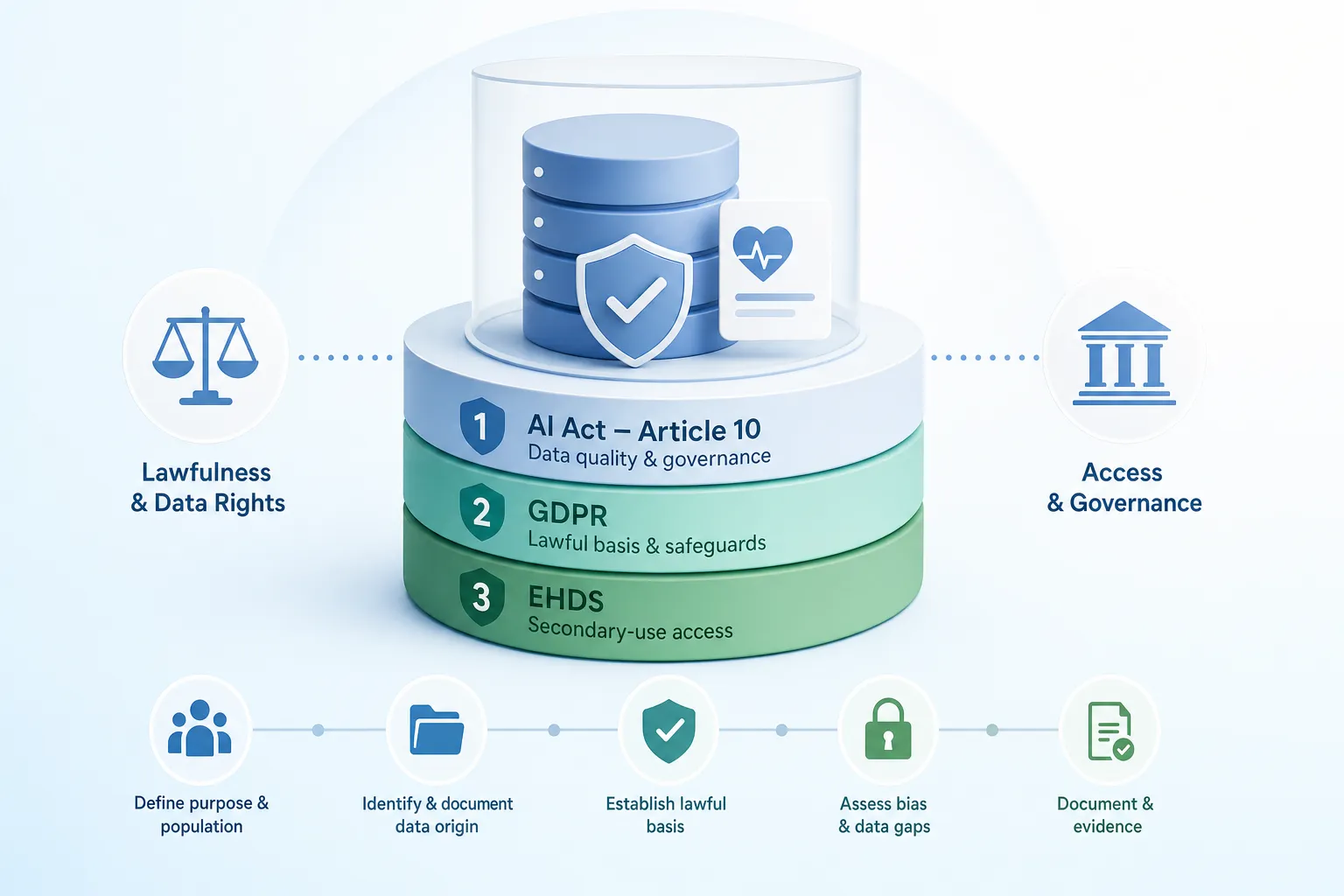
Training data for medical AI in the EU: AI Act Article 10, GDPR and the EHDS
Article 10 of the AI Act, GDPR and the EHDS govern medical AI training data in the EU. Practical guidance for life sciences teams on sourcing it lawfully.
